
Australia’s Social Media Ban Hits Hard as 4.7 Million Under 16 Accounts Are Removed
Australia’s crackdown on underage social media use has led to the removal of an estimated 4.7 million accounts, intensifying debate over online safety, enforcement power, and the future of youth digital access.
PEOPLE & COMMUNITY
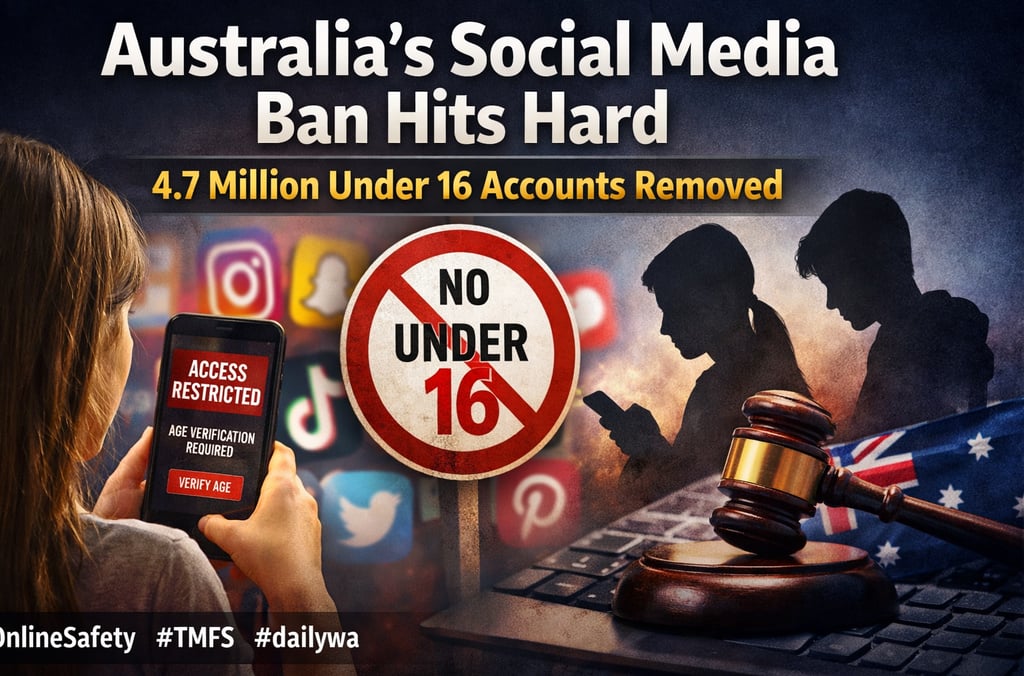
Few policy decisions reshape daily behaviour as quickly as those that redraw the boundaries of digital life. Australia’s enforcement of stricter age based social media restrictions has done exactly that. With an estimated 4.7 million accounts linked to users under the age of sixteen now removed, the scale of the intervention has sent a clear message. The era of voluntary compliance in youth online safety is giving way to firm regulation and measurable consequence.
The removals follow sustained pressure on social media platforms to actively enforce age limits rather than rely on self declaration. For years, age restrictions existed largely in theory, undermined by simple workarounds and minimal verification. This latest action marks a turning point. Platforms are no longer being judged on policy statements, but on outcomes. The purge demonstrates that authorities expect visible, quantifiable enforcement.
The rationale behind the ban is grounded in growing concern about the impact of social media on young people. Research continues to link excessive use with anxiety, sleep disruption, and exposure to harmful content. Policymakers argue that delaying access is not about censorship, but about development. Childhood and early adolescence are increasingly viewed as periods requiring stronger digital guardrails, particularly as algorithms become more immersive and persuasive.
Yet the scale of the account removals has reignited debate over proportionality and practicality. Removing millions of accounts in one sweep raises questions about accuracy, appeals, and unintended consequences. Some legitimate users may be caught in automated processes. Others may simply migrate to new accounts or alternative platforms. Enforcement at this scale exposes the tension between policy intent and real world behaviour.
Parents sit at the centre of this shift. For many families, social media has become embedded in social connection, schooling, and identity formation. A sudden removal of access can feel disruptive, even if the long term goal is protection. The ban places renewed responsibility on households to manage digital behaviour offline, not just through platform controls.
Platforms themselves face a recalibration of power and accountability. Complying with stricter enforcement requires investment in age verification systems, content moderation, and compliance reporting. These changes alter the economics of user growth, particularly in younger demographics. The removals signal that regulatory risk now outweighs the benefit of inflated user numbers.
There is also a broader governance signal at play. Australia is positioning itself as one of the more assertive jurisdictions in digital regulation. By backing policy with enforcement, it is testing how far governments can go in shaping online environments traditionally governed by private companies. Other countries are watching closely, weighing whether similar approaches are feasible or politically viable.
Critics argue that bans alone cannot address deeper issues of digital literacy, peer pressure, and online culture. Without parallel investment in education and youth support, restrictions risk becoming symbolic rather than transformative. Supporters counter that limits are a necessary first step. You cannot moderate what you refuse to define.
From a systems perspective, the purge highlights how quickly digital norms can shift once rules are enforced consistently. Behaviour adapts. Platforms adjust. Users respond. What once seemed impossible becomes routine. This dynamic is familiar in other regulated environments, from financial compliance to public safety standards. Consistency changes expectations.
At TMFS, we see this moment as emblematic of a wider recalibration between technology, regulation, and social responsibility. When systems scale rapidly, oversight often lags. Correction, when it comes, is rarely gentle. The challenge lies in ensuring that enforcement is matched with clarity, fairness, and long term strategy rather than reactive cycles.
The removal of 4.7 million under sixteen accounts is more than a headline. It is a stress test of digital governance. It asks whether safety can be enforced at scale, whether platforms can adapt without eroding trust, and whether society is prepared to rethink how young people engage with technology.
Australia has made its position clear. Online childhood will be regulated, not assumed. The real measure of success will not be the number of accounts removed, but whether the digital environment that follows is healthier, more transparent, and better aligned with the needs of the next generation.
All rights belong to their respective owners. This article contains references and insights based on publicly available information and sources. We do not claim ownership over any third party content mentioned.
DAILY WA © 2025
Daily WA Online is an independent news and media platform covering Western Australia. Owned by TMFS International Pty Ltd., we publish local stories, business insights, lifestyle features, and community voices for the digital era.