
Boorloo Bridge Pedestrian Access Fully Opened to the Public
Pedestrian access across Boorloo Bridge has been fully opened, enhancing connectivity between key precincts and expanding active transport options in Perth.
TECHNOLOGY & INNOVATION
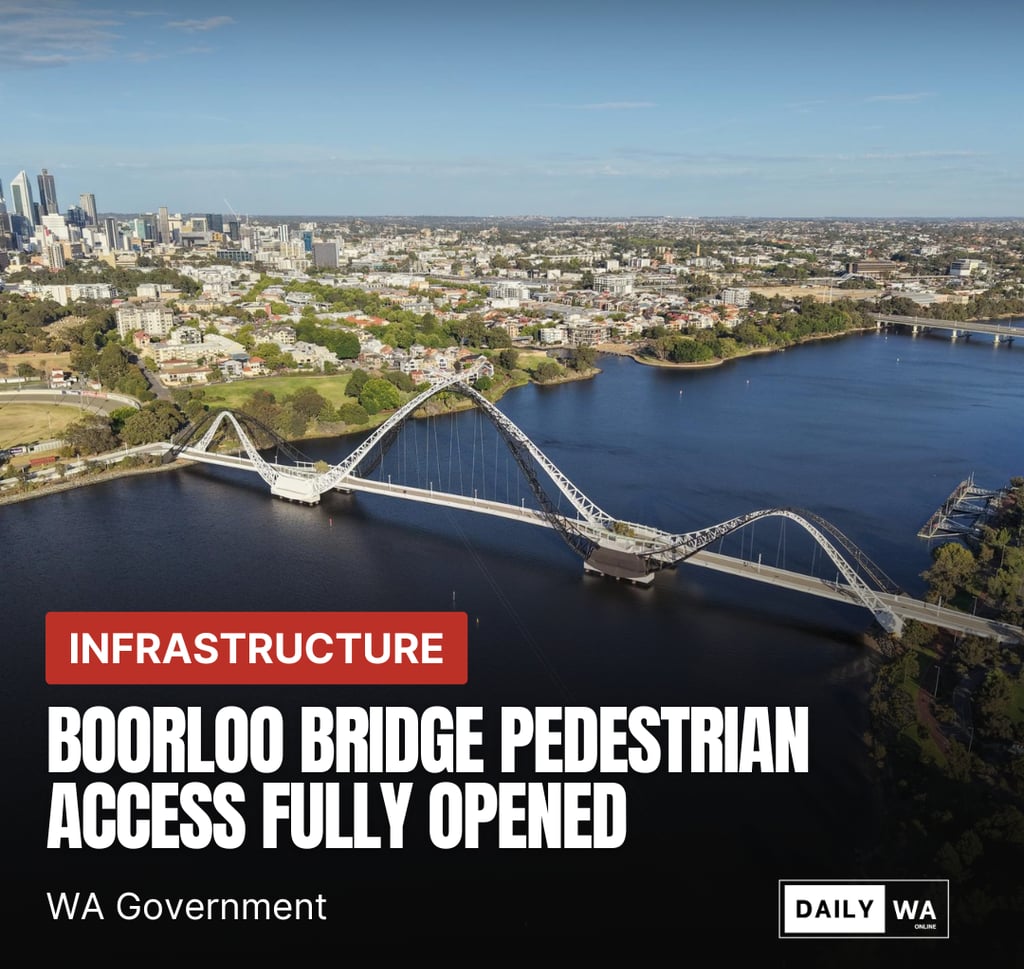
A new chapter in Perth’s urban connectivity has begun with full pedestrian access now open across Boorloo Bridge, marking a significant milestone in the city’s evolving infrastructure landscape.
The completion of pedestrian pathways delivers uninterrupted access for walkers and cyclists, strengthening links between key cultural, sporting, and residential precincts. Designed to encourage active transport, the bridge offers a safe and direct route across the Swan River, reshaping how residents and visitors move through the city.
Infrastructure of this scale does more than span water. It connects communities. The opening signals a broader commitment to integrating urban planning with accessibility, ensuring that foot traffic and cycling infrastructure are prioritised alongside road networks.
For daily commuters, the bridge provides an alternative to vehicle travel, supporting sustainable transport choices. For families and recreational users, it opens new routes for leisure, exercise, and tourism.
The project also reflects recognition of Perth’s growing population and the need for diversified transport corridors. As density increases, reliance on car based travel alone places pressure on roads and surrounding infrastructure. Expanding pedestrian and cycling networks strengthens urban resilience.
Located within the heart of Perth, Boorloo Bridge complements existing landmarks and river crossings, enhancing visual identity while delivering practical function. The structure’s design integrates lighting and safety features to support round the clock use.
Government representatives have highlighted the bridge’s role in linking major event venues and public spaces, particularly during large gatherings when efficient pedestrian flow becomes essential. Improved connectivity reduces congestion and improves crowd management.
Across Western Australia, infrastructure investment increasingly emphasises multimodal transport. Projects that accommodate pedestrians, cyclists, and public transport users reflect evolving expectations around liveability and sustainability.
Community response to the opening has been positive, with residents welcoming expanded access and the opportunity to explore new riverfront routes. Early usage levels are expected to grow as awareness spreads and commuting patterns adjust.
At TMFS, we observe that infrastructure projects achieve lasting impact when they combine utility with accessibility. A bridge that supports both mobility and community experience strengthens the broader urban fabric.
With pedestrian access now fully operational, Boorloo Bridge stands as both functional crossing and symbolic connector. In a city defined by river and skyline, it represents forward movement in how Perth links people, places, and possibility.
All rights belong to their respective owners. This article contains references and insights based on publicly available information and sources. We do not claim ownership over any third party content mentioned.
DAILY WA © 2025
Daily WA Online is an independent news and media platform covering Western Australia. Owned by TMFS International Pty Ltd., we publish local stories, business insights, lifestyle features, and community voices for the digital era.