
Column: Why Regional Students Deserve Better Transport Options
In regional Western Australia, limited transport options are quietly undermining education access, placing unnecessary barriers in the path of students whose postcode already shapes opportunity.
OPINION & VOICES
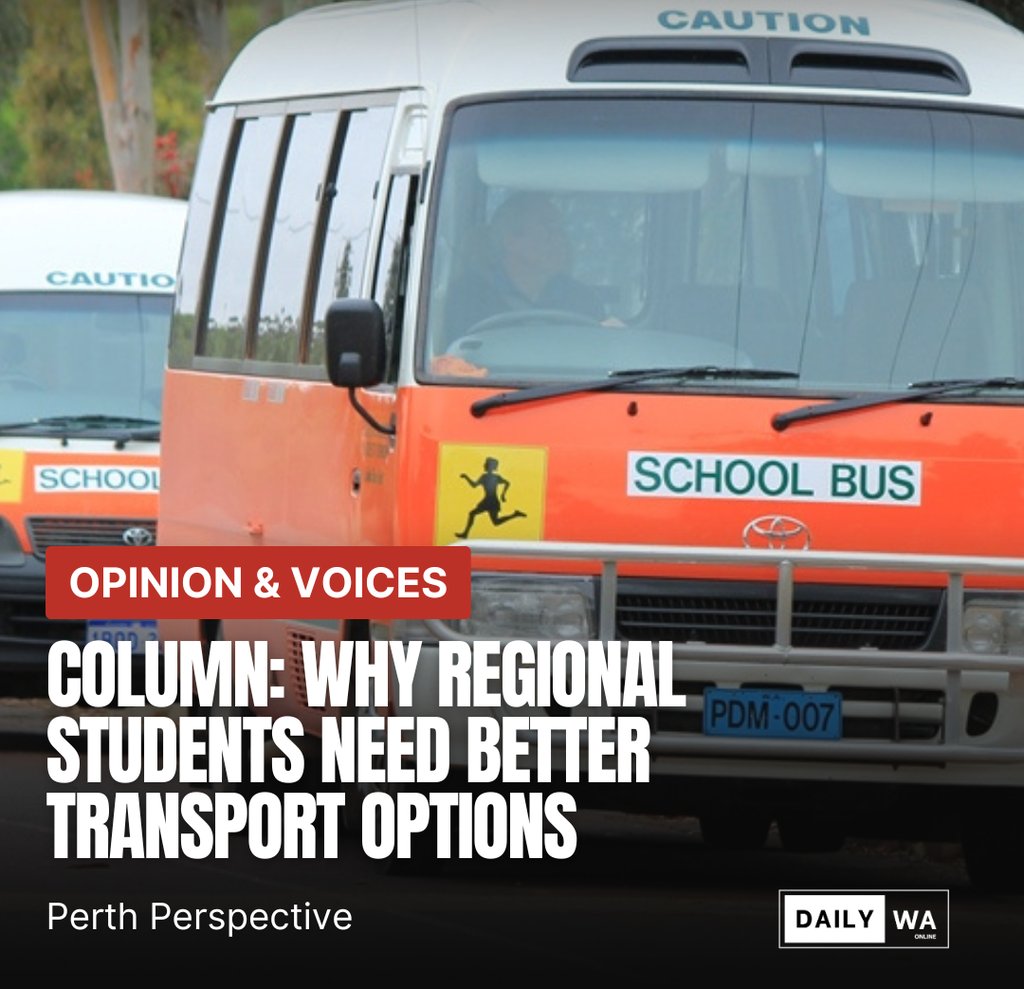
For many students in regional Western Australia, the school day begins long before the first lesson and ends well after the final bell. The reason is not homework or extracurriculars. It is transport. Limited, unreliable, or non existent options are shaping educational access in ways that rarely make headlines but have lasting consequences.
Distance is an accepted reality of regional life. What should not be accepted is that geography alone determines whether a student can attend school consistently, participate fully, or access enrichment opportunities. Yet for many families, transport remains the defining constraint. Long travel times, infrequent services, and gaps between school schedules and public transport timetables place a quiet but persistent burden on students.
In some communities, school buses cover vast routes, collecting students before sunrise and returning them home after dark. Fatigue becomes routine. Concentration suffers. Participation in after school programs becomes impossible when the only ride home leaves immediately after classes end. Education becomes something to endure rather than engage with.
For secondary students, the challenges often intensify. Subject choice can depend on whether transport exists to reach a larger school or specialist facility. Vocational training, apprenticeships, and work placements frequently require travel beyond local catchments. Without reliable transport, these pathways close, not because of ability or motivation, but because of logistics.
The issue is particularly acute for students from low income households. Private transport is not always an option, and the cost of fuel, vehicle maintenance, or multiple daily trips can be prohibitive. When transport becomes a financial stress, education is no longer an equal opportunity system. It becomes conditional.
There are broader social implications as well. School is more than a place of learning. It is a hub for connection, support, and identity. When students cannot stay for tutoring, sport, cultural activities, or mentoring because they cannot get home safely, their sense of belonging erodes. Over time, disengagement becomes more likely.
Policy discussions around regional education often focus on curriculum, staffing, and infrastructure. These are essential. But transport is the connective tissue that allows those investments to function. A well resourced school is of limited value if students struggle to reach it consistently or arrive exhausted.
Solutions do not require reinvention. They require coordination. Aligning school schedules with regional transport services. Expanding flexible bus routes. Supporting community led transport initiatives. Investing in safe, reliable options that reflect how students actually live and travel. These measures are practical, achievable, and proven in other jurisdictions.
There is also an economic argument. Education outcomes influence workforce readiness, regional retention, and long term productivity. When students are forced to limit aspirations because transport is inadequate, regions lose potential talent. Improving access is not just a social good. It is an investment in regional sustainability.
In Western Australia, where distance defines so much of daily life, transport should be treated as core education infrastructure. Roads, buses, and timetables shape opportunity just as surely as classrooms and teachers. Ignoring that reality places responsibility on families and students to overcome systemic gaps on their own.
At TMFS, we observe that access issues are rarely isolated. Transport, education, and regional development intersect continuously. When one is neglected, pressure shifts to the others. Addressing transport for regional students is a leverage point. It improves attendance, engagement, wellbeing, and long term outcomes simultaneously.
This is not a call for excess. It is a call for fairness. Regional students already navigate fewer choices and greater distances. They should not also bear the cost of systems designed without their reality in mind.
Better transport options will not solve every challenge facing regional education. But without them, many other solutions fall short. If the goal is to offer genuine opportunity regardless of postcode, then ensuring students can get to and from school safely, reliably, and with dignity must be part of the answer.
Education policy does not end at the school gate. It begins on the road that leads to it.
All rights belong to their respective owners. This article contains references and insights based on publicly available information and sources. We do not claim ownership over any third party content mentioned.
DAILY WA © 2025
Daily WA Online is an independent news and media platform covering Western Australia. Owned by TMFS International Pty Ltd., we publish local stories, business insights, lifestyle features, and community voices for the digital era.