
Crane Collapse onto Passenger Train Kills at Least 22 in Thailand as Rescue Efforts Continue
At least 22 people have been killed and dozens injured after a construction crane collapsed onto a moving train in Thailand’s Nakhon Ratchasima province, triggering a major emergency response and urgent investigations into the cause.
NEWS & CURRENT AFFAIRS
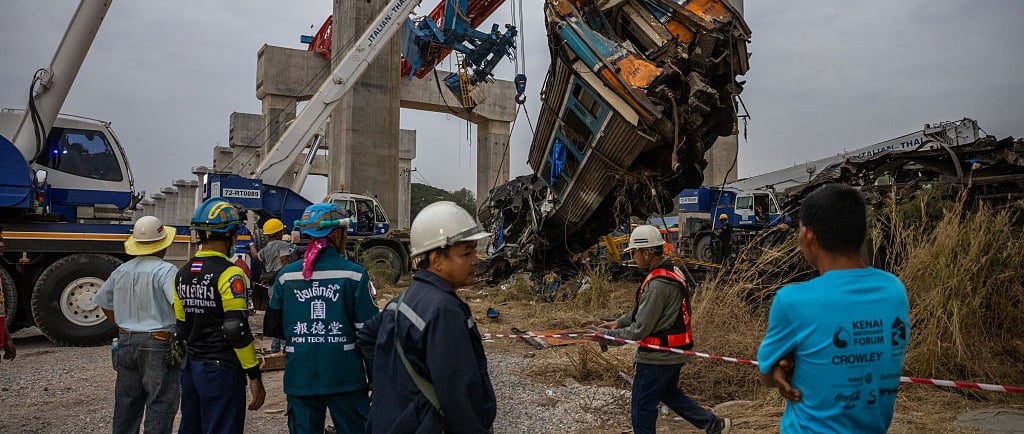
A catastrophic infrastructure failure has left Thailand reeling after a construction crane collapsed onto a moving passenger train, killing at least 22 people and injuring dozens more. The crash occurred in Nakhon Ratchasima, a major transport corridor north of Bangkok, where rescue teams have been working through twisted debris in a race to reach survivors and recover victims.
According to authorities, the crane fell directly onto the train as it travelled beneath an active construction zone. Several carriages were crushed on impact, leaving passengers trapped amid metal wreckage. Emergency crews were deployed rapidly, with firefighters, medical teams, and disaster response units coordinating a complex rescue operation under unstable conditions.
Scenes from the site have highlighted the scale of the destruction. Mangled train carriages and the collapsed crane dominate the area, while responders continue carefully removing debris to avoid further collapse. Hospitals across the region have been placed on high alert as the injured are treated for trauma ranging from fractures to critical injuries.
The incident has raised urgent questions about construction safety near live transport infrastructure. Rail lines are among the most sensitive environments for heavy construction activity, requiring strict separation, load management, and constant monitoring. When those controls fail, consequences can be immediate and deadly. Authorities have confirmed that a formal investigation is underway to determine whether structural failure, human error, or breaches of safety protocol contributed to the collapse.
For passengers, the crash was sudden and unavoidable. Survivors have described a violent impact followed by darkness, dust, and panic as the train came to an abrupt halt. Such incidents deeply undermine public confidence in transport systems, which rely on layered safety controls to protect passengers from risks outside their control.
The tragedy also places renewed scrutiny on rapid infrastructure development. Thailand, like many countries expanding rail and urban projects, faces the challenge of balancing growth with rigorous safety enforcement. Large scale construction brings economic benefit, but without uncompromising oversight, it can also introduce catastrophic risk where systems intersect.
Crane failures are among the most serious hazards in construction. International safety data shows they are rarely caused by a single factor, instead emerging from a combination of issues such as ground instability, overloading, inadequate inspection, or breakdowns in communication. Investigators will now be tasked with reconstructing the sequence of events to determine how safeguards failed.
Beyond immediate rescue efforts, attention will turn to accountability and reform. Families of those killed are seeking answers, and public confidence will depend on whether findings are made transparent and corrective action follows. History shows that meaningful safety improvements often come only after tragedies expose weaknesses that were previously overlooked or tolerated.
From a broader perspective, the incident underscores how interconnected modern infrastructure has become. Construction, transport, and public safety operate as a single system. When coordination breaks down, the effects ripple far beyond the construction site itself, affecting commuters, communities, and national trust in essential services.
At TMFS, we observe that high impact failures often reveal systemic gaps rather than isolated mistakes. Resilience in complex environments depends on proactive risk management, empowered safety oversight, and the willingness to halt operations when conditions become unsafe. These principles apply across sectors, but are especially critical where public lives are directly at stake.
As rescue teams continue their work in Nakhon Ratchasima and investigators begin the painstaking task of determining what went wrong, the focus remains on those affected by the tragedy. The loss of life is a stark reminder that infrastructure progress must never outpace protection.
The crane collapse stands as a sobering lesson for construction and transport systems worldwide. Safety is not an accessory to development. It is the foundation upon which public trust and long term progress depend.
All rights belong to their respective owners. This article contains references and insights based on publicly available information and sources. We do not claim ownership over any third party content mentioned
DAILY WA © 2025
Daily WA Online is an independent news and media platform covering Western Australia. Owned by TMFS International Pty Ltd., we publish local stories, business insights, lifestyle features, and community voices for the digital era.