
Editorial: Western Australia Must Prepare Now for Rapid Population Growth
Western Australia is entering a period of accelerated population growth that will test infrastructure, housing, and services, demanding long term planning decisions made with urgency rather than hindsight.
OPINION & VOICES
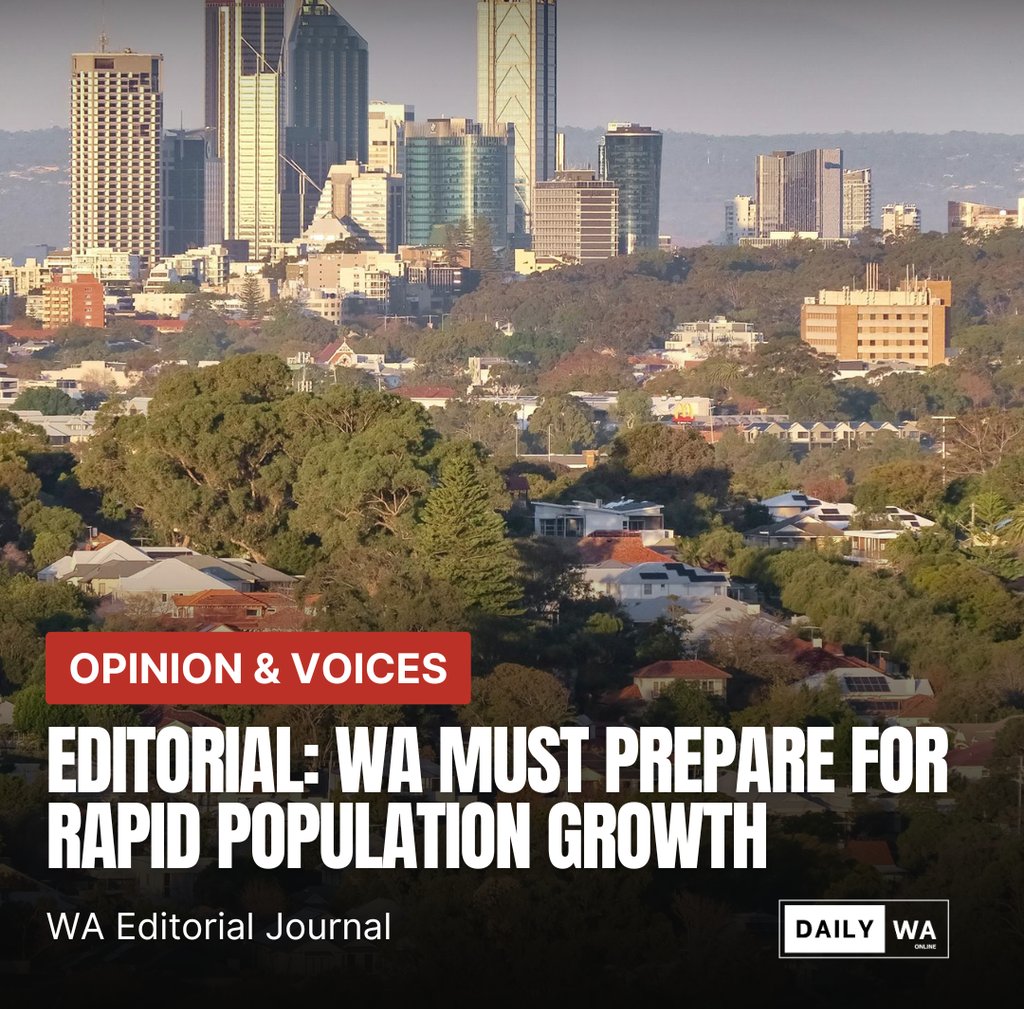
Population growth is often framed as a sign of success. More people mean more workers, stronger demand, and greater economic potential. But without preparation, growth can just as easily become a source of strain. Western Australia now stands at that inflection point. The pace of population increase is accelerating, and the decisions made in the near term will determine whether growth strengthens the state or exposes its vulnerabilities.
For much of its history, Western Australia has experienced population change in waves, often linked to economic cycles. Today’s growth is different. It is broader, more sustained, and shaped by a mix of interstate migration, international arrivals, and natural increase. This momentum is placing pressure on systems that were not designed for rapid or prolonged expansion.
Housing is the most visible stress point. Demand has surged faster than supply, pushing affordability beyond reach for many households. Shortages are no longer confined to inner city markets. They are now evident across suburban and regional areas, affecting workers essential to healthcare, education, construction, and emergency services. Without coordinated action, housing scarcity risks undermining the very growth the state seeks to attract.
Infrastructure faces similar pressure. Transport networks, hospitals, schools, and utilities are being asked to do more with assets planned for smaller populations. Congestion, service delays, and stretched facilities are early warning signs of systems approaching capacity. Retrofitting infrastructure after growth has occurred is invariably more expensive and disruptive than planning ahead.
The challenge is not simply one of scale, but of timing. Population growth often arrives faster than approvals, construction, and workforce expansion can respond. Long planning cycles clash with immediate demand. This mismatch creates gaps that communities feel daily, from longer commutes to delayed access to care.
There is also a regional dimension. Growth is not evenly distributed. Some areas are absorbing new residents rapidly, while others struggle to attract the workforce they need. Strategic population planning must consider how housing, employment, and services are aligned geographically. Growth without balance risks deepening inequality between regions.
Critically, preparation requires more than funding announcements. It demands integrated planning across government portfolios and cooperation with industry and local communities. Housing policy cannot be separated from transport planning. Health infrastructure cannot be planned independently of population distribution. Fragmented decision making leads to fragmented outcomes.
Western Australia has advantages that many jurisdictions envy. Space, economic opportunity, and a reputation for liveability provide a strong foundation. But these advantages can erode if growth is allowed to outpace planning. Liveability is not automatic. It is the result of deliberate, sustained investment in systems that support daily life.
The conversation must also move beyond short term fixes. Temporary incentives and reactive measures may ease pressure at the margins, but they do not address structural imbalance. Preparing for population growth means thinking in decades, not election cycles. It means accepting that some decisions will be costly upfront but far more expensive if delayed.
From a social perspective, unmanaged growth carries real consequences. Communities experience frustration when services lag and housing becomes scarce. Trust in institutions weakens when people feel growth is happening to them rather than for them. Maintaining social cohesion requires that planning keeps pace with expectation.
At TMFS, we observe that the most resilient systems are those built before stress becomes visible. Population growth is a predictable force. Its impacts can be modelled, anticipated, and planned for. Failure to act early is rarely due to lack of information. It is usually the result of delayed commitment.
Western Australia is at a moment where foresight matters. The state can choose to prepare deliberately, aligning housing, infrastructure, and services with projected growth. Or it can continue responding incrementally, absorbing cost and disruption as pressure builds.
Growth is not the problem. Unprepared growth is. The opportunity before Western Australia is to turn momentum into strength by planning with clarity, coordination, and long term intent. The cost of delay will not be abstract. It will be felt in daily life, across communities, for years to come.
The time to prepare is not when systems fail. It is now, while choices still shape outcomes rather than repair damage.
All rights belong to their respective owners. This article contains references and insights based on publicly available information and sources. We do not claim ownership over any third party content mentioned.
DAILY WA © 2025
Daily WA Online is an independent news and media platform covering Western Australia. Owned by TMFS International Pty Ltd., we publish local stories, business insights, lifestyle features, and community voices for the digital era.