
End of Financial Year Sales: Common Traps Australian Shoppers Should Avoid
EOFY sales can offer genuine bargains, but they can also lead to unnecessary spending. Here's how to avoid the most common End of Financial Year sales traps.
BUSINESS & ECONOMY
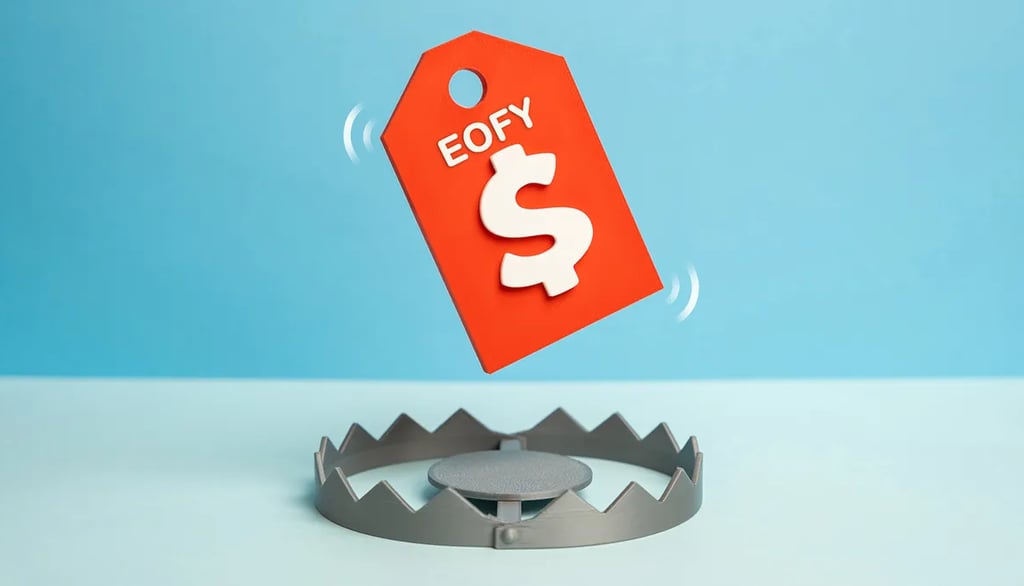
The End of Financial Year (EOFY) sales period is one of Australia's biggest retail events. From electronics and appliances to furniture and fashion, retailers promote major discounts designed to attract bargain hunters.
While genuine deals do exist, consumer experts warn that EOFY sales can also encourage impulse spending and costly mistakes.
Here are some of the most common EOFY sales traps and how to avoid them.
Assuming Every Discount Is a Bargain
One of the biggest mistakes shoppers make is believing that a large percentage discount automatically means a good deal.
Retailers often advertise:
40% off
50% off
Clearance pricing
Limited-time offers
However, the original price may have been inflated or rarely charged in practice.
Before buying, compare prices across multiple retailers and check historical pricing where possible.
Buying Something Just Because It's on Sale
A discount does not create value if you did not need the item in the first place.
Many shoppers spend hundreds of dollars during EOFY on products they never intended to purchase before seeing the promotion.
A useful question to ask is:
"Would I still buy this item if it were not on sale?"
If the answer is no, it may not be a genuine saving.
Falling for Artificial Urgency
Retailers frequently use phrases such as:
Ends tonight
Final hours
Limited stock
Last chance
While some offers genuinely expire, these marketing tactics are designed to create pressure and reduce thoughtful decision-making.
Taking time to compare options often leads to better financial outcomes.
Ignoring Total Cost
For larger purchases, shoppers sometimes focus only on the discount rather than the total amount being spent.
Saving $500 on a $3,000 television still means spending $2,500.
The real question is whether the purchase fits your budget and financial goals.
Overusing Buy Now, Pay Later Services
Services such as Afterpay and Zip can make purchases feel more affordable by spreading payments over time.
However, multiple purchases can quickly accumulate into significant debt obligations.
Financial counsellors often advise treating Buy Now, Pay Later purchases the same way you would any other debt commitment.
Forgetting About Return Policies
Not all EOFY sale items have standard return rights.
Some clearance and final-sale products may have more restrictive refund or exchange conditions.
Before purchasing:
Check return policies
Understand warranty coverage
Confirm exchange options
Keep receipts and records
Chasing Tax Deductions Incorrectly
EOFY sales often target small business owners and employees with messages about tax deductions.
A common misunderstanding is that a tax deduction makes an item free.
A deduction generally reduces taxable income, not the full purchase cost.
Buying something unnecessary purely for a deduction can still leave you financially worse off.
If tax treatment is important, consult a qualified tax professional.
Ignoring Future Financial Goals
Large sale periods can distract from bigger financial priorities such as:
Building savings
Paying down debt
Creating an emergency fund
Investing
Planning major purchases
Every dollar spent during EOFY is a dollar unavailable for other financial goals.
How to Shop Smart During EOFY
Before making a purchase:
✅ Create a shopping list
✅ Set a spending limit
✅ Compare prices
✅ Research product reviews
✅ Check return policies
✅ Avoid impulse purchases
✅ Focus on genuine needs
These simple steps can help separate real value from marketing hype.
EOFY sales can be an excellent opportunity to save money on products you genuinely need. The key is approaching discounts with a clear plan rather than reacting to promotional pressure.
The most successful shoppers are not necessarily the ones who buy the most. They are often the ones who know exactly what they need, understand its value, and resist spending simply because something appears to be a bargain.
A good deal is only a good deal if it helps your finances, not hurts them.
All rights belong to their respective owners. This article contains references and insights based on publicly available information and sources. We do not claim ownership over any third-party content mentioned.
DAILY WA © 2025
Daily WA Online is an independent news and media platform covering Western Australia. Owned by TMFS International Pty Ltd., we publish local stories, business insights, lifestyle features, and community voices for the digital era.