
Kimberley Charity Steps Up to Fund Essential School Supplies for Remote Students
A Kimberley based charity has launched a fundraising effort to provide essential school supplies to remote communities, helping reduce barriers to learning and support students where access and affordability remain ongoing challenges.
PEOPLE & COMMUNITY
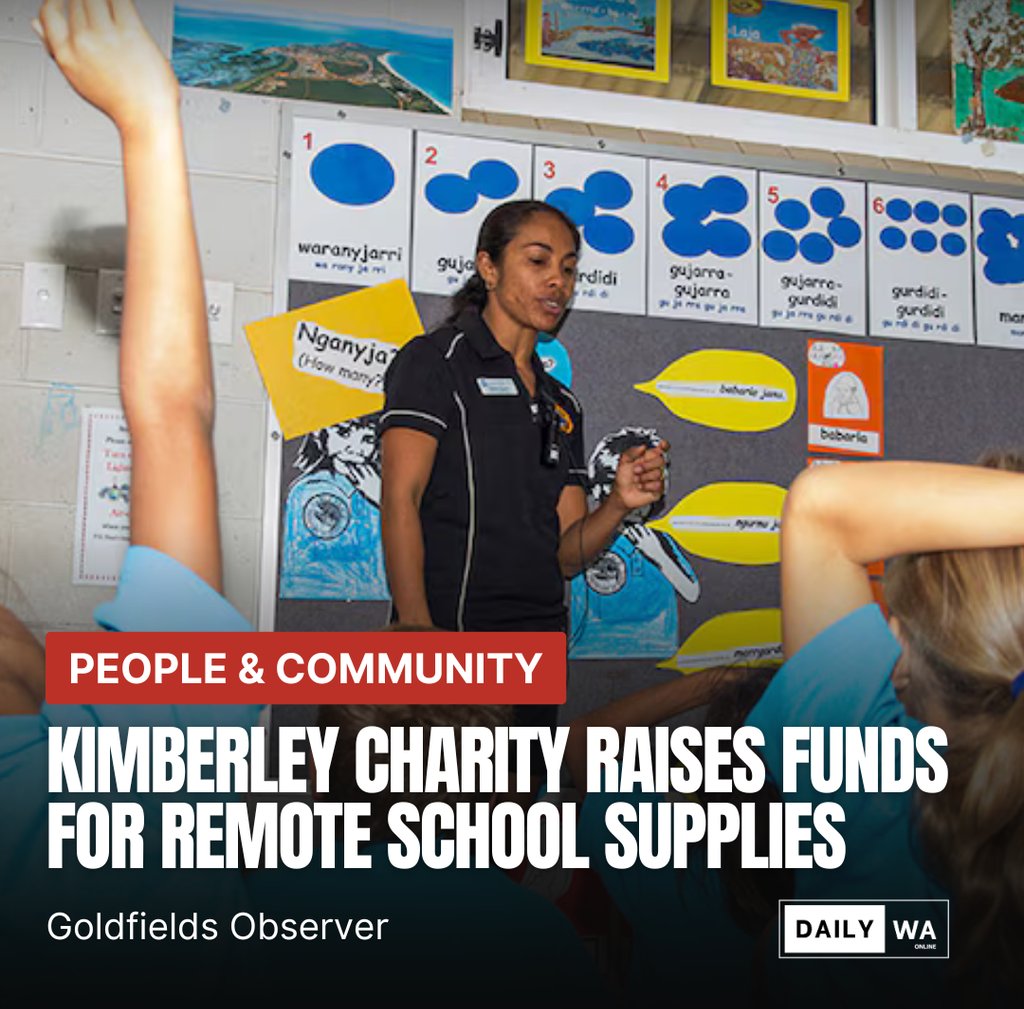
In some of Western Australia’s most remote communities, access to education depends on far more than curriculum and classrooms. It depends on whether students have the basic tools needed to learn. A Kimberley charity’s latest fundraising effort is focused on closing that gap, raising funds to deliver essential school supplies to children in isolated areas where distance, cost, and limited services continue to shape daily life.
Remote schools across the Kimberley face challenges that are rarely visible to metropolitan communities. Stationery, books, uniforms, and learning materials often need to be transported vast distances, driving up costs and delaying availability. For families already under financial pressure, these barriers can directly affect attendance, engagement, and confidence in the classroom.
The charity behind the initiative works closely with local schools and community leaders to identify what is most needed. Rather than distributing generic packs, supplies are tailored to age groups, curriculum requirements, and cultural context. This approach ensures resources are practical, relevant, and immediately useful once they arrive.
Fundraising efforts have drawn strong local support, with individuals, businesses, and community groups contributing through donations and events. Organisers say the response reflects a shared understanding that education is a foundation for long term opportunity, particularly in regions where pathways can be limited by geography.
Teachers in remote schools have welcomed the initiative, noting that access to basic supplies can significantly influence classroom participation. When students have the same tools as their peers, it reduces stigma and allows learning to take centre stage. Consistency also helps educators plan lessons without needing to adapt constantly to shortages.
Beyond immediate learning outcomes, the program carries broader social impact. Education is closely linked to health, employment, and community resilience. Supporting students early helps build confidence and continuity, reducing the risk of disengagement later on. In remote communities, these effects are amplified, as schools often function as central hubs of connection and support.
Logistics remain one of the biggest hurdles. Delivering supplies to remote areas requires careful coordination, reliable transport, and strong local partnerships. The charity works with regional networks to ensure materials reach schools efficiently and at the right time in the school year, minimising disruption and maximising benefit.
The initiative also highlights the importance of locally informed solutions. Remote education challenges cannot be solved solely through centralised policy. Community led efforts, grounded in on the ground knowledge, often respond more quickly and flexibly to need. This charity’s work reflects that principle in action.
At TMFS, we observe that effective community programs share common traits. They identify practical gaps, collaborate closely with local stakeholders, and focus on outcomes rather than visibility. Supporting education through basic resources may appear modest, but its impact compounds over time.
As fundraising continues, organisers hope to expand the program to reach more schools and provide ongoing support rather than one off assistance. The aim is continuity, ensuring students begin each school year equipped and ready to learn.
The Kimberley charity’s efforts are a reminder that educational equity is shaped by everyday realities. A pencil, a workbook, or a school bag can influence a child’s confidence as much as any policy. By addressing these fundamentals, the initiative helps ensure that where a child lives does not determine how well they can learn.
All rights belong to their respective owners. This article contains references and insights based on publicly available information and sources. We do not claim ownership over any third party content mentioned.
DAILY WA © 2025
Daily WA Online is an independent news and media platform covering Western Australia. Owned by TMFS International Pty Ltd., we publish local stories, business insights, lifestyle features, and community voices for the digital era.