
Midday Violence at Rockingham Centre Sparks Urgent Calls for Stronger Security Measures
A violent midday brawl involving teenagers reportedly armed with knives and scooters has raised serious concerns about public safety, prompting renewed calls for increased security and preventative action at major shopping centres.
NEWS & CURRENT AFFAIRS
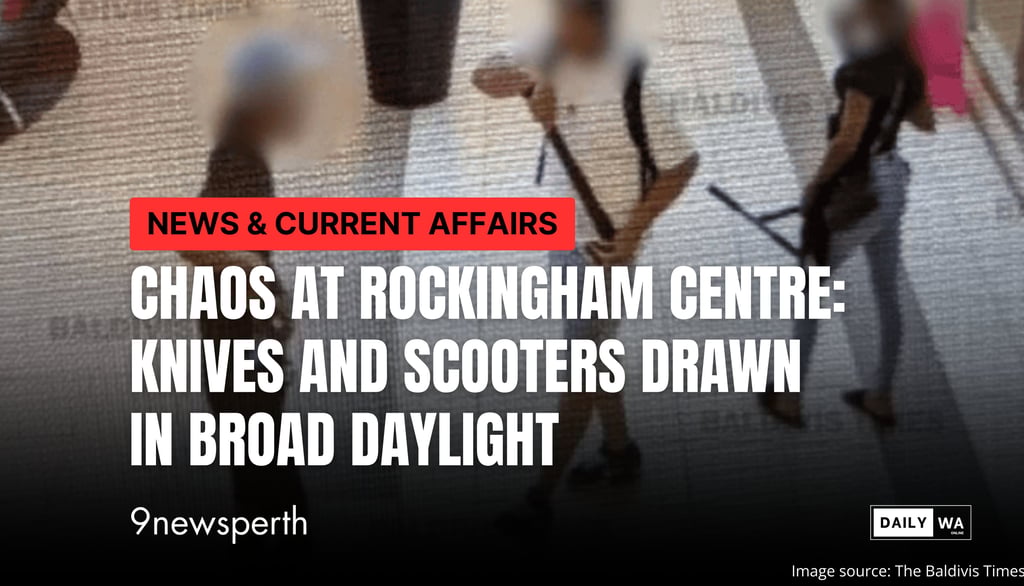
Public spaces are built on an unspoken agreement. People expect to gather, shop, and move freely without fear. When that expectation is broken, the impact travels far beyond the immediate incident. The reported midday brawl at Rockingham Centre involving teenagers, knives, and scooters has done exactly that. It has unsettled shoppers, alarmed families, and reignited urgent debate about safety, supervision, and security in shared community spaces.
Midday incidents carry particular weight. They occur when centres are busy with families, older residents, workers on lunch breaks, and students moving through public areas. The visibility of violence at such a time intensifies concern because it challenges the assumption that danger is confined to late night hours or isolated settings. Witness accounts describing youths brandishing weapons and using scooters as part of the altercation have sharpened public anxiety and raised questions about how such situations are able to escalate so quickly.
Shopping centres are no longer just retail hubs. They function as social meeting points, transport interchanges, and informal youth gathering spaces. This evolution brings both opportunity and risk. When behaviour turns aggressive, the density of people and lack of clear escape routes can amplify danger. Security responses must therefore be rapid, coordinated, and visible. Community members are now asking whether existing measures are sufficient for the realities these spaces face today.
Calls for increased security presence are not driven by fear alone. They are rooted in prevention. Research into public space safety consistently shows that visible security personnel, clear behavioural expectations, and early intervention reduce the likelihood of violent escalation. A strong security presence also reassures the public, restoring confidence that safety is being actively managed rather than reactively addressed.
The involvement of teenagers adds another layer of complexity. Youth related incidents often reflect broader social pressures, including disengagement, lack of supervision, and the influence of social media driven conflict. While enforcement is necessary to protect the public, long term solutions require collaboration between schools, families, community organisations, and local authorities. Preventing violence begins well before it reaches a shopping centre floor.
Retail workers are among those most affected. Staff members are rarely trained to manage violent confrontations, yet they are often the first exposed when incidents unfold. Increased security not only protects shoppers but provides frontline workers with confidence that they are not left to manage volatile situations alone. Workplace safety in public facing roles has become an increasingly prominent issue, and incidents like this underscore the need for systemic support.
The economic and social implications should not be underestimated. When people feel unsafe, they change behaviour. Foot traffic declines. Families avoid certain locations. Community trust erodes. Over time, this affects businesses, employment, and the vibrancy of local centres. Proactive security investment is therefore not just a safety measure but a safeguard for community wellbeing and economic stability.
Technology also plays a role. Surveillance systems, real time monitoring, and coordinated communication between centre management and police can significantly improve response times. However, technology is most effective when paired with trained personnel who can interpret situations and act decisively. The current public discussion reflects a growing understanding that safety requires both human presence and system level coordination.
From a broader perspective, the Rockingham incident reflects a pattern being observed in many urban and suburban centres. Public spaces are under pressure to balance accessibility with control, openness with safety. Achieving this balance demands leadership, investment, and clear accountability. It also requires acknowledging that security challenges evolve and that responses must evolve with them.
At TMFS, we observe similar dynamics across environments where risk, public trust, and operational readiness intersect. Whether in transport hubs, commercial precincts, or community facilities, safety systems must be designed to anticipate escalation rather than respond after harm occurs. Prevention, visibility, and clarity of responsibility are central to maintaining confidence in shared spaces.
As investigations continue and details are clarified, the focus is shifting toward what comes next. Community members are seeking assurance that this incident will lead to tangible change rather than fade into memory. Increased security presence, stronger youth engagement strategies, and clearer behavioural enforcement are all part of the conversation now taking shape.
What happened at Rockingham Centre is confronting, but it also presents an opportunity. An opportunity to reassess how public spaces are protected, how young people are supported, and how communities respond when safety is compromised. Trust is not restored through statements alone. It is rebuilt through visible action, consistent standards, and a shared commitment to keeping public spaces safe for everyone.
All rights belong to their respective owners. This article contains references and insights based on publicly available information and sources. We do not claim ownership over any third party content mentioned.
DAILY WA © 2025
Daily WA Online is an independent news and media platform covering Western Australia. Owned by TMFS International Pty Ltd., we publish local stories, business insights, lifestyle features, and community voices for the digital era.