
Mysterious Smoking Object Found in Western Australia Likely Space Debris, Experts Say
A group of miners in Western Australia made a startling discovery — a smoking metallic object in the outback that experts now believe may be an unexpected remnant of space debris.
NEWS & CURRENT AFFAIRS
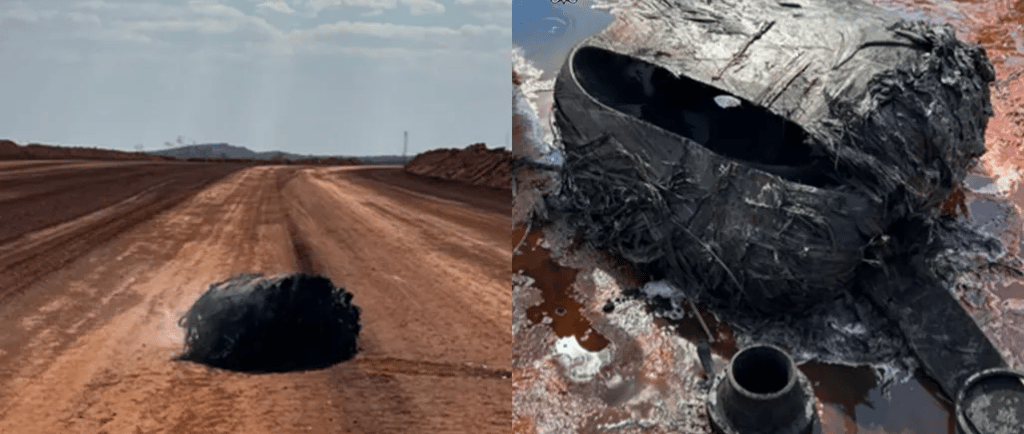

In the quiet expanse of Western Australia’s red desert, a team of miners recently stumbled upon a scene that felt almost cinematic. A smoking, metallic object lay half-buried in the dust, its scorched surface still warm to the touch. What began as curiosity quickly evolved into national intrigue, as experts rushed to investigate what many now believe is space debris — a rare and striking reminder of how the modern world’s presence extends far beyond the boundaries of Earth.
According to initial reports, the miners were conducting routine operations when they noticed a plume of thin smoke rising from a distant ridge. Upon closer inspection, they found what appeared to be a large cylindrical fragment of metal, measuring several metres long, with markings resembling aerospace material. The object’s edges were blackened, suggesting intense heat during re-entry through the atmosphere.
Authorities were quick to cordon off the area, and the Australian Space Agency (ASA) was called in to assess the find. Early analyses indicate that the object could be a component of a spacecraft or satellite that re-entered Earth’s atmosphere unexpectedly. Similar incidents have occurred globally as the amount of orbital debris continues to grow, posing challenges for both space agencies and environmental management efforts on Earth.
Space debris, often referred to as orbital junk, consists of defunct satellites, spent rocket stages, and fragments from previous missions. While most of it burns up harmlessly during re-entry, larger pieces can occasionally survive the descent, reaching the surface. Western Australia’s wide, uninhabited terrain makes it a natural landing zone for such rare occurrences.
Experts from Curtin University’s Space Science and Technology Centre are now working with federal authorities to confirm the object’s origin. Dr. Amelia Roth, a senior astrophysicist involved in the investigation, commented that the debris likely comes from a decommissioned satellite or a spent rocket booster. “The characteristics we’ve seen so far — the composition, the heat damage, and the dimensions — are consistent with upper-stage rocket components,” she said.
This discovery has reignited discussions about the global responsibility of managing space waste. As the number of active satellites and commercial launches increases exponentially, so too does the risk of uncontrolled re-entry events. The European Space Agency estimates that more than 36,000 tracked objects larger than ten centimetres are currently orbiting Earth, with countless smaller fragments remaining unmonitored.
For Western Australia, this is not the first encounter with fallen space remnants. In 1979, debris from NASA’s Skylab station famously landed near the town of Esperance, where locals even issued a humorous littering fine to the United States government. The new discovery, while far less dramatic in scale, echoes that same blend of wonder and caution that accompanies humanity’s relationship with space exploration.
Local authorities have advised residents not to approach or touch unidentified metallic objects found in remote areas, as re-entry debris can contain hazardous materials. The ASA has stated that recovery teams will handle the object under controlled conditions before transporting it to Perth for detailed examination.
Beyond the scientific intrigue, the incident highlights a deeper question about accountability in space. As nations and private companies race to launch satellites, the need for coordinated policies on debris mitigation has become urgent. Experts advocate for stricter international agreements to ensure de-orbiting protocols are followed, reducing the likelihood of uncontrolled re-entries in the future.
While investigations continue, the object has already captured the public imagination. It stands as both a relic of human ingenuity and a symbol of the unintended consequences that accompany technological ambition. What once orbited silently above the Earth now rests amid the red soil of Western Australia, a stark reminder that every innovation carries its echo.
For the miners who found it, the experience is something they will likely never forget — an ordinary workday transformed into an extraordinary encounter with the unknown. For scientists, it serves as a critical data point in understanding how our expanding footprint in space is beginning to leave tangible traces back home.
In a world increasingly defined by connection and exploration, the fallen object is a quiet messenger from the frontiers of modern science. It reminds us that progress, though vast and inspiring, must always be balanced by responsibility — both in the skies above and on the ground below.
All rights belong to their respective owners. This article contains references and insights based on publicly available information and sources. We do not claim ownership over any third-party content mentioned.
DAILY WA © 2025
Daily WA Online is an independent news and media platform covering Western Australia. Owned by TMFS International Pty Ltd., we publish local stories, business insights, lifestyle features, and community voices for the digital era.