
NASA’s Nancy Grace Roman Telescope explained: How it will map space 1,000 times faster than Hubble
The Nancy Grace Roman Telescope is set to transform space exploration, with NASA promising it will map the universe up to 1,000 times faster than the Hubble Space Telescope.
TECHNOLOGY & INNOVATION
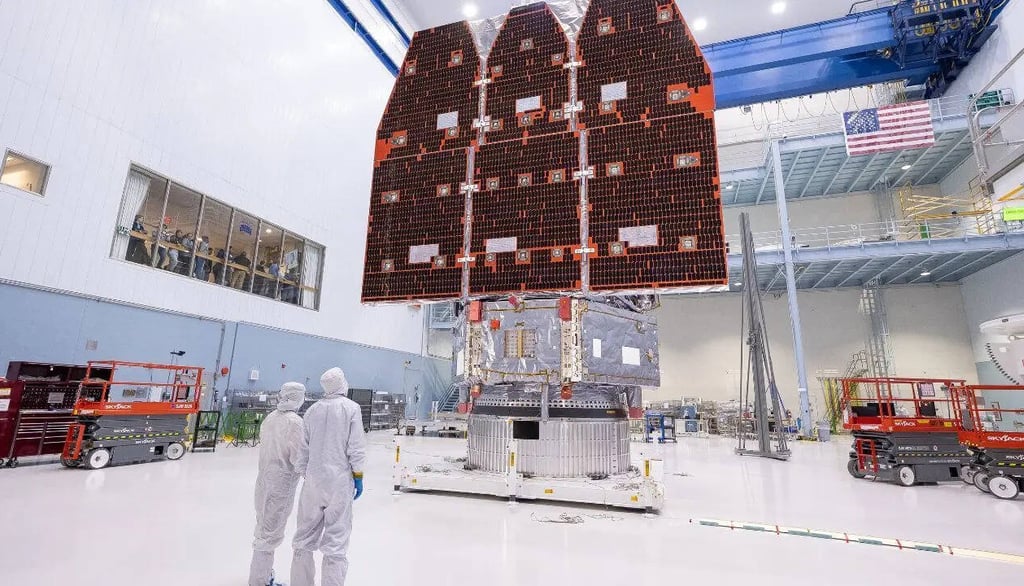
Nancy Grace Roman Telescope Explained: How NASA Will Map Space 1,000 Times Faster Than Hubble
The Nancy Grace Roman Telescope is set to transform space exploration, with NASA promising it will map the universe up to 1,000 times faster than the Hubble Space Telescope.
Designed as a next-generation observatory, the Nancy Grace Roman Telescope will capture vast areas of space in a single image, allowing scientists to study the universe on an unprecedented scale.
Nancy Grace Roman Telescope Explained
The Nancy Grace Roman Telescope is a powerful infrared space telescope developed by NASA. It is named after Nancy Grace Roman, often called the “mother of Hubble,” who played a key role in advancing space astronomy.
Unlike Hubble, which focuses on smaller, detailed sections of space, the Nancy Grace Roman Telescope is built for wide-field observations. This means it can scan much larger portions of the sky at once.
How It Maps Space Faster Than Hubble
The key advantage of the Nancy Grace Roman Telescope is its wide field of view. It can capture images that are about 100 times larger than Hubble’s while maintaining similar resolution.
This allows the Nancy Grace Roman Telescope to survey huge regions of space much more quickly. Over time, this results in mapping speeds up to 1,000 times faster than Hubble for certain types of observations.
This capability makes it ideal for large-scale surveys of galaxies, stars, and cosmic structures.
What the Telescope Will Study
The Nancy Grace Roman Telescope will focus on some of the biggest questions in astronomy. One major goal is to study dark energy, the mysterious force driving the expansion of the universe.
It will also search for exoplanets using advanced techniques like gravitational microlensing. This could help identify thousands of new planets beyond our solar system.
The Nancy Grace Roman Telescope will also map the distribution of galaxies to better understand how the universe has evolved over time.
Why It Matters
The Nancy Grace Roman Telescope represents a major step forward in space observation. By combining wide-field imaging with high resolution, it fills a gap between telescopes like Hubble and newer missions.
Its ability to collect massive amounts of data quickly will accelerate discoveries and provide a more complete picture of the universe.
The Nancy Grace Roman Telescope could help answer fundamental questions about the nature of space, time, and cosmic expansion.
Challenges and Expectations
Like any major space mission, the Nancy Grace Roman Telescope faces technical and logistical challenges. Building and launching such a complex instrument requires precision and careful planning.
However, expectations are high. Scientists believe the Nancy Grace Roman Telescope will open new frontiers in astronomy and lead to discoveries that are currently beyond our imagination.
Looking Ahead
Once operational, the Nancy Grace Roman Telescope will work alongside other observatories, complementing their strengths and expanding our understanding of the cosmos.
Its speed and scale will allow researchers to explore the universe in ways never before possible.
Conclusion
The Nancy Grace Roman Telescope is poised to become one of NASA’s most important tools for studying the universe. With its ability to map space 1,000 times faster than Hubble, it marks a new era in astronomy.
As the mission moves forward, the Nancy Grace Roman Telescope promises to unlock new insights into the structure and history of the cosmos.
All rights belong to their respective owners. This article contains references and insights based on publicly available information and sources. We do not claim ownership over any third party content mentioned.
DAILY WA © 2025
Daily WA Online is an independent news and media platform covering Western Australia. Owned by TMFS International Pty Ltd., we publish local stories, business insights, lifestyle features, and community voices for the digital era.