
New Coastal Protection Measures Announced for Erosion Risk Suburbs Across Western Australia
New coastal protection measures have been announced for erosion risk suburbs, as authorities move to safeguard homes, infrastructure, and beaches amid growing pressure from rising seas and severe weather.
NEWS & CURRENT AFFAIRS
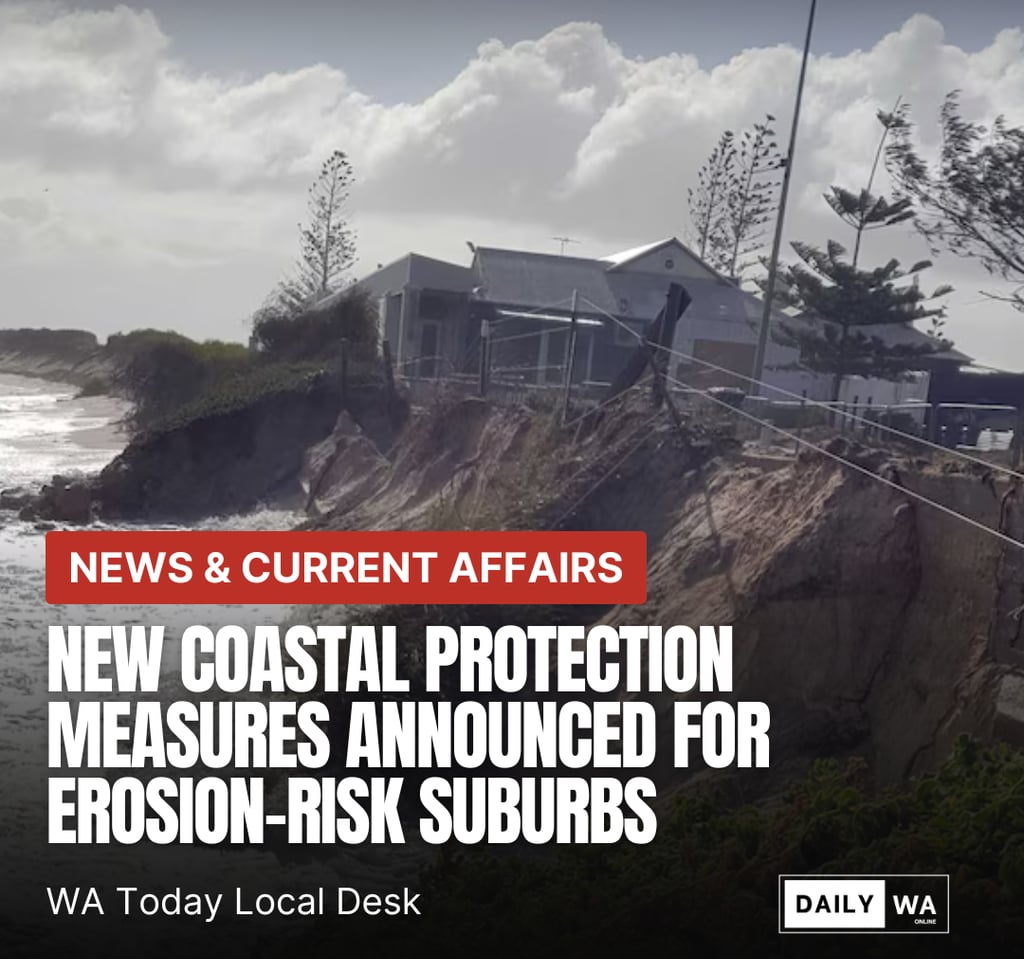
Coastal erosion is no longer a distant or abstract concern for Western Australia’s shoreline communities. It is a visible and accelerating challenge, reshaping beaches, threatening homes, and placing long term infrastructure at risk. In response, new coastal protection measures have been announced for erosion risk suburbs, signalling a more proactive approach to managing one of the state’s most pressing environmental pressures.
Authorities say the measures are designed to stabilise vulnerable coastlines while balancing environmental protection, community access, and long term resilience. Rising sea levels, stronger storm surges, and changing weather patterns have increased erosion rates in several coastal suburbs, prompting calls for action from residents, councils, and environmental experts.
The new approach focuses on a mix of engineered and nature based solutions. Planned works include targeted seawalls, dune restoration, sand nourishment, and improved coastal monitoring. Rather than relying on a single intervention, officials are emphasising adaptive strategies that can evolve as conditions change. This reflects growing recognition that coastal management must be flexible, evidence driven, and responsive to local conditions.
Several metropolitan and regional suburbs have been identified as priorities due to repeated storm damage and ongoing shoreline retreat. In these areas, erosion has already encroached on public infrastructure such as footpaths, roads, and recreational spaces. Without intervention, authorities warn that damage costs and safety risks would continue to escalate.
Community consultation forms a central part of the rollout. Coastal protection often involves difficult trade offs between preserving natural landscapes and defending built assets. Residents are being invited to engage with planning processes to ensure solutions reflect both scientific advice and local values. Transparency, officials say, is essential to maintaining trust as works progress.
Environmental groups have welcomed the focus on long term planning but caution that hard infrastructure alone cannot solve erosion. They argue that restoring natural systems such as dunes and vegetation is critical to absorbing wave energy and maintaining healthy coastlines. The inclusion of dune rehabilitation and sand replenishment has been viewed as a positive step toward more balanced outcomes.
The announcement also reflects broader policy shifts in how governments respond to climate driven risk. Rather than reacting after damage occurs, coastal protection is increasingly framed as a form of preventative infrastructure investment. Early intervention reduces long term costs, limits disruption, and provides greater certainty for communities facing gradual but persistent change.
For local governments, the measures offer much needed coordination and support. Coastal erosion often crosses council boundaries, complicating responsibility and funding. A state led framework helps align planning standards, technical expertise, and investment priorities, reducing fragmented responses to a shared challenge.
From a social perspective, protecting coastlines is about more than property. Beaches play a central role in Western Australia’s identity, tourism economy, and lifestyle. Erosion threatens public access and amenity, not just private assets. Safeguarding these spaces preserves community wellbeing alongside environmental and economic value.
At TMFS, we observe that resilience planning is most effective when it anticipates slow moving risks before they become crises. Coastal erosion is a textbook example. It rarely makes headlines until damage is severe, yet its progression is measurable and predictable. Acting early reflects disciplined long term thinking rather than short term reaction.
Authorities have acknowledged that coastal protection is not a one time solution. Ongoing monitoring, maintenance, and adaptation will be required as sea levels continue to rise and weather patterns evolve. The current measures are positioned as the foundation of a broader, long horizon strategy rather than a final fix.
As works begin in erosion risk suburbs, attention will turn to outcomes. Communities will be watching closely to see whether the measures deliver stability without sacrificing the character of the coastline. The success of the program will shape future investment decisions and set expectations for how Western Australia manages its most vulnerable coastal zones.
What is clear is that the conversation has shifted. Coastal erosion is no longer being treated as an isolated environmental issue. It is now recognised as a shared challenge requiring coordinated planning, sustained investment, and community engagement. The measures announced mark a significant step in that direction.
All rights belong to their respective owners. This article contains references and insights based on publicly available information and sources. We do not claim ownership over any third party content mentioned.
DAILY WA © 2025
Daily WA Online is an independent news and media platform covering Western Australia. Owned by TMFS International Pty Ltd., we publish local stories, business insights, lifestyle features, and community voices for the digital era.