
Opinion: Western Australia’s Creative Industry Needs Long Term Funding, Not Short Term Fixes
Western Australia’s creative sector continues to deliver cultural, social, and economic value, yet without long term funding certainty its potential remains constrained by short cycles and fragile support structures.
OPINION & VOICES
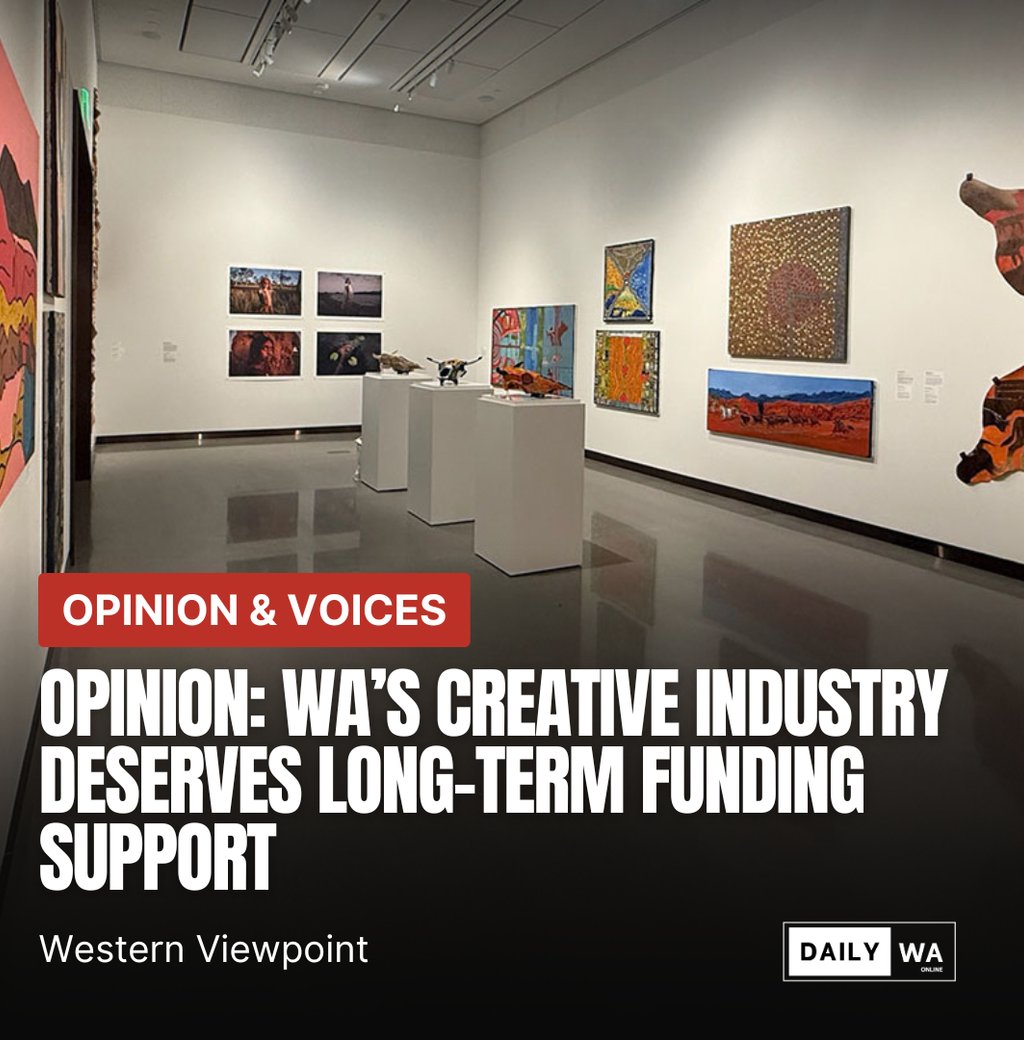
Western Australia’s creative industry is often celebrated in moments of success. Festival launches, sold out performances, international recognition. Yet behind these highlights sits a sector operating with persistent uncertainty, shaped by short term funding models that limit stability, growth, and ambition. If the state is serious about building a resilient creative economy, long term funding support is no longer optional. It is essential.
The creative sector contributes far more than cultural enrichment. It generates employment, drives tourism, activates public spaces, and strengthens community identity. From performing arts and music to design, film, digital media, and visual arts, creative work intersects with education, mental health, and regional development. Its value is both measurable and deeply felt, yet funding structures rarely reflect this breadth of impact.
Short funding cycles create a fragile environment. Organisations are forced into constant application mode, diverting energy away from artistic development and audience engagement toward survival. Projects are compressed into unrealistic timelines. Skilled practitioners move interstate or exit the industry altogether in search of stability. The loss is cumulative, eroding capability that takes years to rebuild.
This instability is particularly damaging in a state defined by distance. Western Australia’s creative industry already faces higher costs related to travel, touring, and market access. When funding is uncertain or episodic, those challenges are amplified. Long term investment would allow organisations to plan, collaborate, and innovate with confidence rather than caution.
Regional communities feel this impact acutely. Creative programs are often the first to be cut when funding contracts and the hardest to reinstate once lost. Yet in many regional towns, arts organisations serve as anchors for connection, education, and local identity. Consistent funding enables continuity, ensuring these communities are not left culturally isolated.
There is also a workforce reality that cannot be ignored. Creative professionals are highly skilled, adaptable, and entrepreneurial, but they are not infinitely flexible. Project to project funding discourages long term career development and limits pathways for emerging talent. Without security, mentorship and skills transfer break down, weakening the sector over time.
Other industries benefit from long horizon planning. Infrastructure, energy, and health are funded with an understanding that returns accrue over decades. Creativity deserves the same lens. Cultural output is not an event. It is an ecosystem. Its health depends on sustained nourishment, not intermittent injections.
Long term funding does not mean unconditional support. It enables accountability, measurement, and strategic alignment. Multi year frameworks allow organisations to set clear goals, invest in governance, and demonstrate impact over time. They also reduce administrative burden for funders, shifting focus from volume of applications to quality of outcomes.
Internationally, jurisdictions that treat creative industries as economic drivers rather than discretionary extras see stronger returns. Stable funding correlates with increased private investment, stronger export potential, and higher participation. Western Australia has the talent and the stories. What it lacks is certainty.
In Western Australia, the conversation often centres on diversification. Creative industries are a proven avenue for exactly that. They are less resource intensive, highly scalable, and globally connected. Supporting them long term aligns with broader economic resilience goals rather than competing with them.
At TMFS, we observe that sustainable systems are built when investment matches intent. If creativity is valued only rhetorically, the sector will continue to operate on the margins. If it is valued structurally, through long term funding and policy alignment, it can flourish as a core contributor to the state’s future.
This is not an argument for excess spending. It is an argument for smarter design. Predictable, multi year funding provides leverage. It allows creativity to compound, audiences to grow, and cultural institutions to mature.
Western Australia’s creative industry does not lack vision or capability. It lacks time and certainty. Offering long term funding support is not about indulgence. It is about recognising that culture, like infrastructure, must be built to last.
If the state wants a creative sector that reflects its ambition, diversity, and global outlook, it must fund it with the same patience it expects in return.
All rights belong to their respective owners. This article contains references and insights based on publicly available information and sources. We do not claim ownership over any third party content mentioned.
DAILY WA © 2025
Daily WA Online is an independent news and media platform covering Western Australia. Owned by TMFS International Pty Ltd., we publish local stories, business insights, lifestyle features, and community voices for the digital era.