
Peter Dutton Reignites Nuclear Energy Debate as Australia Weighs Power Security and Cost Pressures
Opposition Leader Peter Dutton has renewed calls for nuclear energy in Australia, arguing it could deliver reliable baseload power and help ease rising electricity costs for households and businesses.
OPINION & VOICES
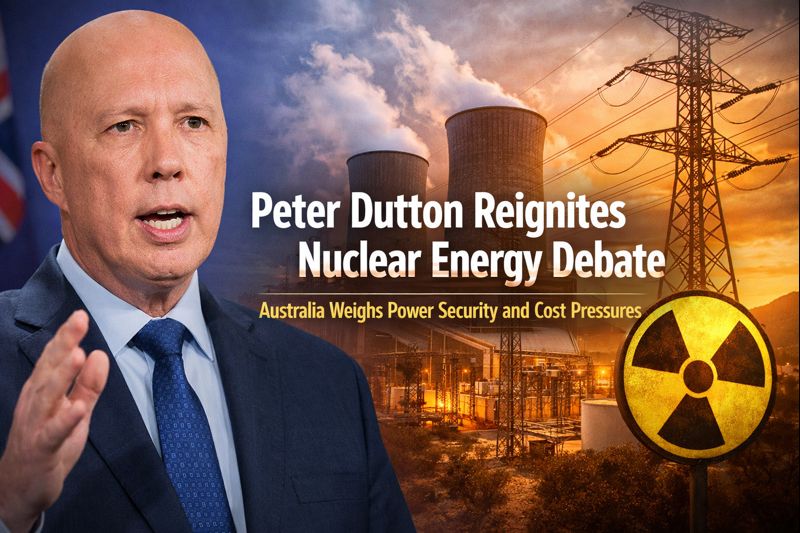
Energy policy debates rarely stay confined to technical detail. They reach directly into households, businesses, and national confidence about the future. That reality is now back in sharp focus as Opposition Leader Peter Dutton has renewed calls for Australia to consider nuclear energy as part of its long term power mix. His argument centres on reliability, affordability, and the growing pressure facing the electricity system as demand rises and prices remain volatile.
Australia’s energy transition is unfolding under competing demands. The shift toward renewables has accelerated, yet concerns persist about grid stability, storage capacity, and the cost burden on consumers. Against this backdrop, nuclear energy is being positioned by its supporters as a technology capable of delivering consistent baseload power without the emissions profile of fossil fuels. The framing is deliberate. Reliability and cost certainty are increasingly influential in public and business sentiment.
For households, electricity bills have become a symbol of broader cost of living pressure. For businesses, particularly energy intensive industries, power costs influence competitiveness, investment decisions, and employment. Dutton’s renewed advocacy primes the debate around practicality rather than ideology, asking whether existing energy pathways alone can meet future needs without compromising affordability or reliability.
Nuclear energy’s appeal lies in its capacity to operate continuously, independent of weather conditions. Unlike solar or wind, it does not require large scale storage to smooth output. Internationally, countries with nuclear capacity often point to its role in stabilising grids and supporting industrial demand. Proponents argue that excluding nuclear from consideration limits Australia’s options at a time when flexibility matters most.
However, the debate is far from settled. Nuclear power carries significant challenges, including high upfront capital costs, long development timelines, regulatory complexity, and unresolved questions around waste management. Australia’s current legislative framework prohibits nuclear power generation, meaning any shift would require major policy reform and public consensus. Critics argue that nuclear would arrive too late to address near term energy pressures and divert resources from faster deployable solutions.
Public perception also plays a decisive role. Nuclear energy evokes strong reactions shaped by historical incidents and concerns about safety. Building social licence would be as critical as building infrastructure. Transparency, regulation, and long term governance would be essential to any credible pathway forward. Without public trust, even technically sound solutions struggle to gain traction.
There is also a strategic dimension unique to Australia. As a major uranium producer, the country sits in an unusual position of exporting nuclear fuel while prohibiting domestic nuclear power. Supporters see this as an inconsistency worth revisiting. Opponents view it as a clear boundary reflecting national values and risk tolerance. The renewed debate forces a reconsideration of whether past assumptions still align with future challenges.
From an economic perspective, energy certainty underpins long term planning. Infrastructure investment, industrial expansion, and advanced manufacturing all depend on predictable power supply. As Australia navigates decarbonisation targets alongside population growth and electrification, the margin for error narrows. The question is no longer whether the energy system will change, but how diversified and resilient it should be.
At TMFS, we observe similar tensions across sectors facing transformation under pressure. When systems are stretched, leaders revisit previously excluded options, not necessarily as immediate solutions, but as part of a broader risk management conversation. Reopening the nuclear debate reflects this dynamic. It signals concern about resilience and a desire to keep strategic options open.
What comes next is likely to be as important as the proposal itself. Detailed modelling, cost analysis, and infrastructure assessment will shape whether nuclear energy remains a political talking point or evolves into a serious policy pathway. The conversation will also test how Australia balances long term planning with short term urgency.
The renewed push from Peter Dutton ensures that nuclear energy is once again part of the national discussion on power security and affordability. Whether it becomes part of Australia’s energy future remains uncertain. What is clear is that the debate reflects deeper questions about how the country prepares for rising demand, economic pressure, and the need for reliable systems that can endure.
As energy policy continues to evolve, decisions made now will shape costs, capability, and confidence for decades. TMFS will continue to engage with discussions where infrastructure, policy, and long term resilience intersect, supporting approaches that prioritise clarity, evidence, and sustainable outcomes over short term positioning.
All rights belong to their respective owners. This article contains references and insights based on publicly available information and sources. We do not claim ownership over any third party content mentioned.
DAILY WA © 2025
Daily WA Online is an independent news and media platform covering Western Australia. Owned by TMFS International Pty Ltd., we publish local stories, business insights, lifestyle features, and community voices for the digital era.