
Peter Malinauskas Defends Opposition to Writers’ Week Appearance as Debate Sharpens on Speech and Responsibility
South Australian Premier Peter Malinauskas has outlined his opposition to the appearance of author Randa Abdel Fattah at Adelaide Writers’ Week, reigniting national discussion around freedom of expression, public responsibility, and the role of cultural institutions during periods of political tension.
OPINION & VOICES
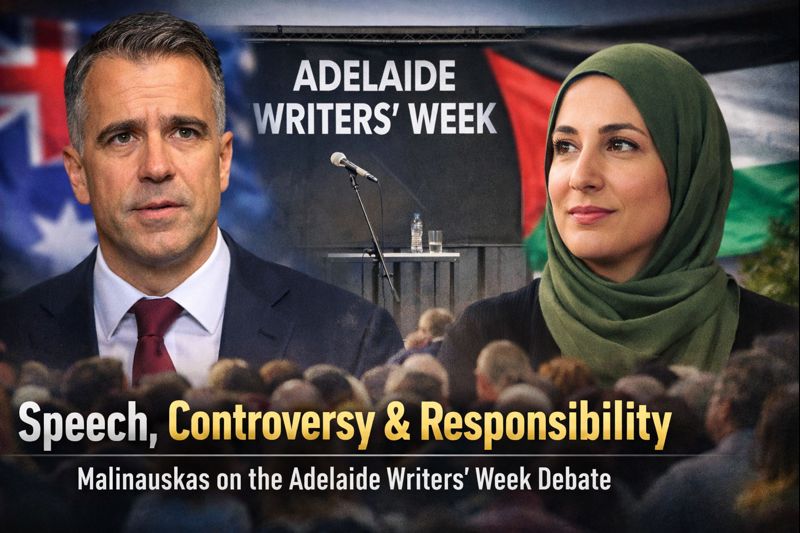
Moments of cultural controversy often reveal deeper questions about leadership, responsibility, and the boundaries of public platforms. That tension is now playing out following comments from South Australian Premier Peter Malinauskas, who has explained his opposition to the appearance of Palestinian Australian author Randa Abdel-Fattah at Adelaide Writers’ Week. Speaking with 7.30, the Premier framed his position within a broader discussion about freedom of expression and the responsibilities attached to major public events.
The issue sits at the intersection of principle and perception. Writers’ festivals have long been regarded as spaces for challenging ideas, dissenting voices, and robust debate. At the same time, they operate as publicly supported cultural institutions with wide audiences and symbolic influence. Malinauskas’ comments reflect concern not about the existence of controversial views, but about how and where they are elevated, particularly during periods of heightened political and social sensitivity.
At the centre of the discussion is a familiar democratic tension. Freedom of expression is a foundational value, yet it does not exist in isolation from consequence. Public platforms confer legitimacy, reach, and authority. Decisions about who is invited to speak are therefore not neutral acts. They shape public discourse and signal institutional endorsement, whether intended or not. The Premier’s intervention primes the public to consider whether all expressions are equally appropriate for all stages.
The context matters. Cultural events do not occur in a vacuum. During times of international conflict and domestic division, language can inflame as easily as it can inform. Leaders are often required to weigh the right to speak against the risk of deepening social fractures. Malinauskas’ stance suggests a view that government leaders have a role in calling attention to those risks, even when doing so invites criticism.
Critics of the Premier’s position argue that opposing an author’s appearance risks setting a troubling precedent. They contend that cultural festivals should remain independent of political pressure and that restricting voices undermines the very purpose of literary engagement. From this perspective, discomfort is not a flaw but a feature of open debate, and shielding audiences from contentious views may weaken democratic resilience rather than strengthen it.
Supporters counter that leadership involves judgement as well as principle. Public responsibility, they argue, includes recognising when platforms may amplify division rather than understanding. In this framing, questioning suitability is not censorship but stewardship. It reflects an effort to balance openness with social cohesion, particularly in spaces designed for broad public participation.
The exchange highlights the evolving role of cultural institutions. Writers’ festivals are no longer niche gatherings. They are nationally visible events, often publicly funded, and increasingly entwined with social and political conversations. As their influence grows, so too does scrutiny of their programming choices. This evolution brings new expectations around accountability and impact.
There is also a broader lesson about modern leadership. Political figures are navigating an environment where silence can be interpreted as endorsement and intervention as overreach. Every position carries risk. Malinauskas’ decision to articulate his view publicly reflects a willingness to engage with complexity rather than defer it. Whether one agrees with his stance or not, it underscores how cultural debates have become arenas for testing values under pressure.
From a systems perspective, this moment illustrates how freedom of expression functions in practice rather than theory. Rights are exercised within institutions, communities, and historical contexts. The challenge lies in maintaining space for diverse voices while preserving trust and social stability. That balance is neither fixed nor easy.
At TMFS, we observe similar dynamics across sectors where public trust, leadership judgement, and institutional responsibility intersect. Long term credibility is built not by avoiding controversy, but by engaging with it thoughtfully and transparently. Decisions made in these moments often define how institutions are perceived long after the immediate debate has passed.
The discussion surrounding Adelaide Writers’ Week is unlikely to conclude neatly. It reflects enduring questions about who decides what is appropriate, how cultural platforms should operate, and where responsibility lies in an era of heightened sensitivity. What is clear is that these debates are becoming more frequent, not less, as culture and politics continue to converge.
In explaining his opposition, Peter Malinauskas has contributed to a national conversation that extends beyond one festival or one author. It is a conversation about how democratic societies manage disagreement, protect expression, and exercise judgement when the stakes are high. The answers will continue to evolve, shaped by context, leadership, and the values communities choose to prioritise.
All rights belong to their respective owners. This article contains references and insights based on publicly available information and sources. We do not claim ownership over any third party content mentioned.
DAILY WA © 2025
Daily WA Online is an independent news and media platform covering Western Australia. Owned by TMFS International Pty Ltd., we publish local stories, business insights, lifestyle features, and community voices for the digital era.