
Vladimir Putin Arrives in China for Xi Jinping Summit Following Donald Trump Visit
Russian President Vladimir Putin has arrived in China for high level talks with Xi Jinping, just days after Donald Trump’s visit heightened global attention on shifting geopolitical alliances.
NEWS & CURRENT AFFAIRS
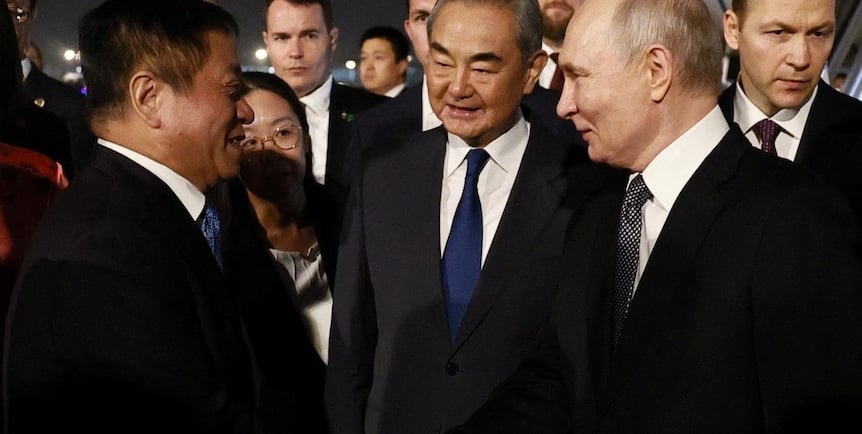
Russian President Vladimir Putin has arrived in China for a major summit with Chinese President Xi Jinping, drawing intense international attention amid rapidly shifting global political dynamics.
The high profile visit comes only days after former US president Donald Trump visited the region, increasing speculation about the evolving balance of power between major world powers.
The summit between Putin and Xi is expected to focus on trade, energy cooperation, security, and strategic coordination as both countries continue strengthening ties in response to growing tensions with Western nations.
Why the Putin-Xi Meeting Matters
Relations between Russia and China have expanded significantly in recent years.
As Western sanctions and diplomatic pressure intensified following the war in Ukraine, Moscow increasingly turned toward Beijing for economic and political support.
China has become one of Russia’s most important trading partners, particularly in areas such as:
Energy exports
Infrastructure projects
Technology cooperation
Financial transactions
Military coordination
The latest summit reinforces what both governments describe as a “strategic partnership” aimed at reshaping global influence.
Timing Raises Global Attention
The timing of Putin’s arrival is attracting particular attention because it follows closely after Donald Trump’s regional visit and renewed discussion about future US foreign policy.
Analysts say the sequence of high level meetings highlights growing geopolitical competition involving:
The United States
China
Russia
NATO allies
Indo-Pacific security partners
Diplomatic symbolism often matters as much as formal agreements during these summits.
Images of Putin and Xi meeting publicly send a message about alignment between the two powers at a time of heightened global instability.
Economic and Energy Discussions Expected
Energy cooperation is expected to be a major focus during the talks.
Russia continues redirecting energy exports toward Asian markets as Europe reduces dependence on Russian resources. China, meanwhile, remains a major buyer of oil and gas needed to support its economy.
Trade between the two countries has expanded rapidly, with both governments increasingly using local currencies instead of relying heavily on the US dollar.
Security and Strategic Cooperation
Military and strategic cooperation are also likely to feature prominently.
Both governments have criticised what they describe as Western dominance in global affairs and have promoted a more multipolar international system.
Joint military exercises and diplomatic coordination between Russia and China have increased in recent years, particularly across Asia and the Pacific region.
The meeting comes during a period of elevated geopolitical tension involving Ukraine, Taiwan, the South China Sea, and Middle East instability.
Global Reactions
Western governments are closely monitoring the summit for signs of deeper military or economic cooperation.
Some analysts view the growing China-Russia relationship as one of the most important geopolitical developments shaping the current international order.
Others argue the partnership remains driven more by shared strategic interests than by full long term alignment.
Final Thoughts
The meeting between Vladimir Putin and Xi Jinping reflects a rapidly changing geopolitical landscape where alliances, trade, and security relationships are being reshaped in real time.
Coming so soon after Donald Trump’s regional visit, the summit also underscores how closely global powers are watching each other’s movements and influence.
As tensions continue across multiple regions, the relationship between China and Russia is likely to remain one of the defining factors shaping international politics in the years ahead.
All rights belong to their respective owners. This article contains references and insights based on publicly available information and sources. We do not claim ownership over any third party content mentioned.
DAILY WA © 2025
Daily WA Online is an independent news and media platform covering Western Australia. Owned by TMFS International Pty Ltd., we publish local stories, business insights, lifestyle features, and community voices for the digital era.