
WA’s Most Powerful Figures Revealed as Influence Extends Beyond Business
A new influence ranking highlights how leadership in Western Australia is increasingly defined by decision making power, public trust, and the ability to shape long term outcomes across industry and government.
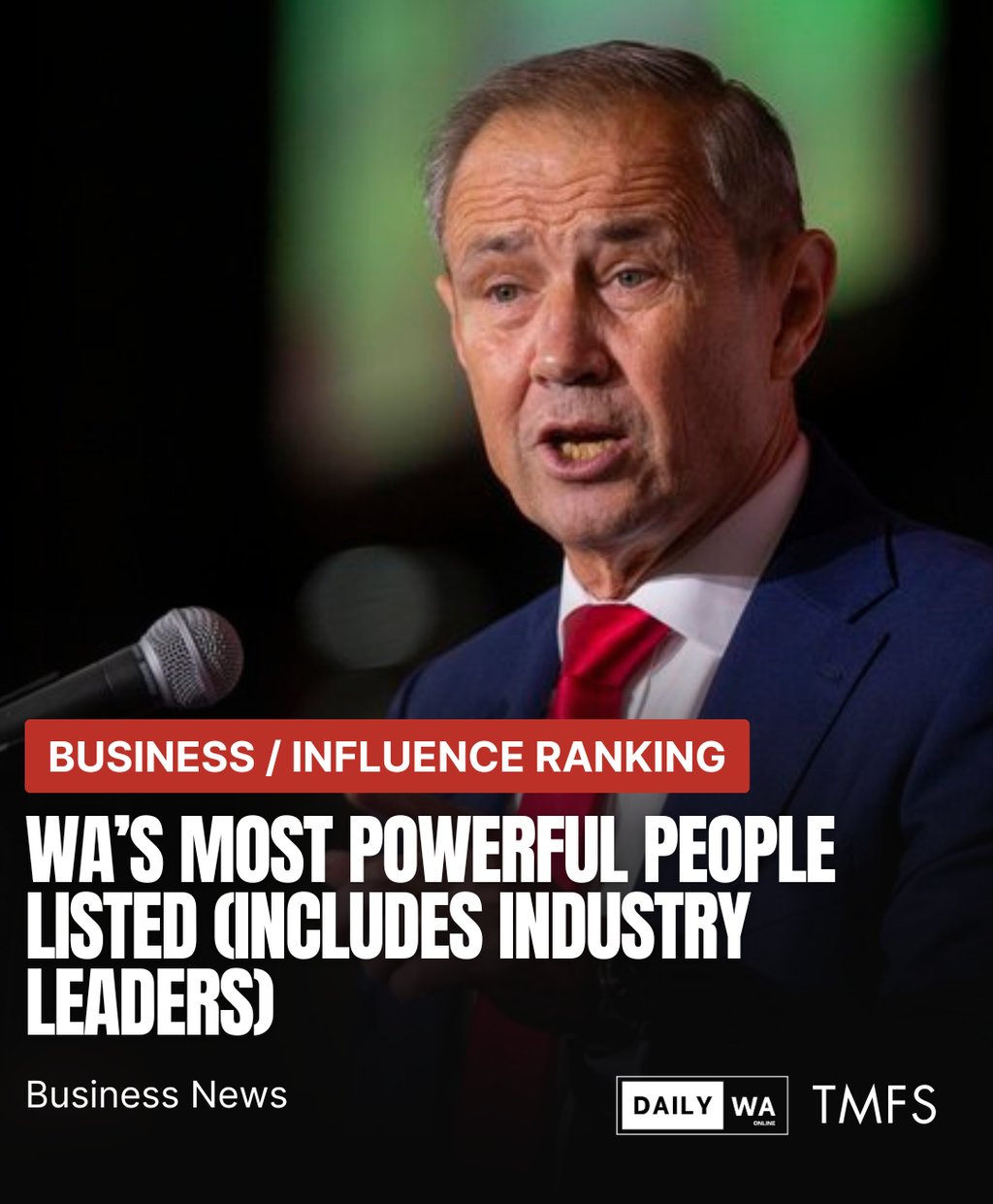
Power in modern Western Australia is no longer confined to boardrooms alone. It is exercised through policy, infrastructure, investment, and the capacity to shape decisions that ripple across communities and industries. The latest ranking of WA’s most powerful people reflects this shift clearly, recognising not only industry leaders but also senior political figures whose influence extends deeply into the state’s economic and social fabric.
Influence rankings offer more than a snapshot of prominence. They provide insight into how authority is exercised and where critical decisions are made. In this year’s list, the presence of figures such as Premier Roger Cook and Deputy Premier Rita Saffioti alongside industry leaders underscores a defining reality. The most consequential power in WA often sits at the intersection of government and business, where policy direction and commercial execution converge.
Western Australia’s economy is shaped by long horizon decisions. Infrastructure planning, resource development, transport networks, housing supply, and energy transition all depend on alignment between public leadership and private capability. Leaders who can coordinate across these domains hold influence that goes well beyond their formal titles. The ranking primes the public to recognise that power today is as much about coordination and credibility as it is about capital or corporate scale.
Roger Cook’s position reflects the central role of political leadership in setting the tone for economic confidence. Government policy determines regulatory certainty, investment appetite, and the pace at which major projects progress. In a state heavily reliant on capital intensive industries, stability and clarity from the top are decisive factors. Political authority in this context becomes a form of economic leverage, shaping decisions made by global investors and local businesses alike.
Rita Saffioti’s inclusion highlights how influence can be concentrated within portfolios that directly touch daily life and long term growth. Transport, infrastructure, and planning are not abstract policy areas. They define how people move, where businesses locate, and how cities and regions evolve. Leaders who oversee these systems wield structural power that compounds over time, influencing productivity, liveability, and regional equity.
Alongside political figures, industry leaders remain central to WA’s power landscape. Executives across mining, energy, property, finance, and logistics continue to shape employment, exports, and technological capability. Their influence is amplified when aligned with public policy objectives, particularly in areas such as decarbonisation, infrastructure expansion, and workforce development. The ranking reflects this dynamic balance, where influence is distributed across sectors but unified by shared responsibility for the state’s trajectory.
What distinguishes this list from traditional power narratives is the emphasis on outcome driven leadership. Influence is increasingly measured by the ability to deliver complex projects, manage risk, and maintain public trust. In an environment defined by global uncertainty, leaders who demonstrate consistency and strategic foresight rise in prominence. Authority is earned through execution as much as position.
There is also a broader lesson embedded in the ranking. Western Australia’s most powerful individuals are operating within systems that demand collaboration rather than dominance. No single sector can advance the state alone. Mining depends on infrastructure. Infrastructure depends on policy. Policy depends on economic viability. Influence therefore becomes relational, built through networks, credibility, and the capacity to align diverse interests toward long term goals.
From a strategic perspective, this evolution mirrors trends seen in other high performing economies. Power shifts away from siloed control toward integrated leadership models. Those who can navigate complexity, balance competing priorities, and sustain momentum over time emerge as the most influential. At TMFS, we observe this pattern consistently. Organisations and leaders who understand system level impact are better positioned to shape durable outcomes.
The ranking also serves as a reminder that influence carries responsibility. Decisions made by those on the list affect not only markets but communities, livelihoods, and future opportunity. As WA continues to grow and diversify, expectations of its leaders will only intensify. Transparency, accountability, and long term thinking will remain essential to maintaining legitimacy and trust.
Ultimately, the list is less about individuals than about the structure of power in Western Australia. It reflects a state where leadership is exercised across government and industry, where collaboration outweighs confrontation, and where influence is measured by the ability to shape outcomes that endure.
As WA navigates its next phase of growth, the figures recognised in this ranking will play a defining role. Their decisions will shape infrastructure corridors, economic resilience, and social cohesion for years to come. TMFS remains committed to supporting leaders and organisations operating at this level of influence, where clarity, governance, and strategic alignment determine the difference between short term impact and lasting legacy.
All rights belong to their respective owners. This article contains references and insights based on publicly available information and sources. We do not claim ownership over any third party content mentioned.
DAILY WA © 2025
Daily WA Online is an independent news and media platform covering Western Australia. Owned by TMFS International Pty Ltd., we publish local stories, business insights, lifestyle features, and community voices for the digital era.