
When Classroom Theory Meets Reality: Why GCSE English Feels So Far Removed from Real Life
A comedy skit uses humour to expose the gap between GCSE English lessons and real world communication, highlighting how academic theory can feel disconnected from everyday experience.
PEOPLE & COMMUNITY
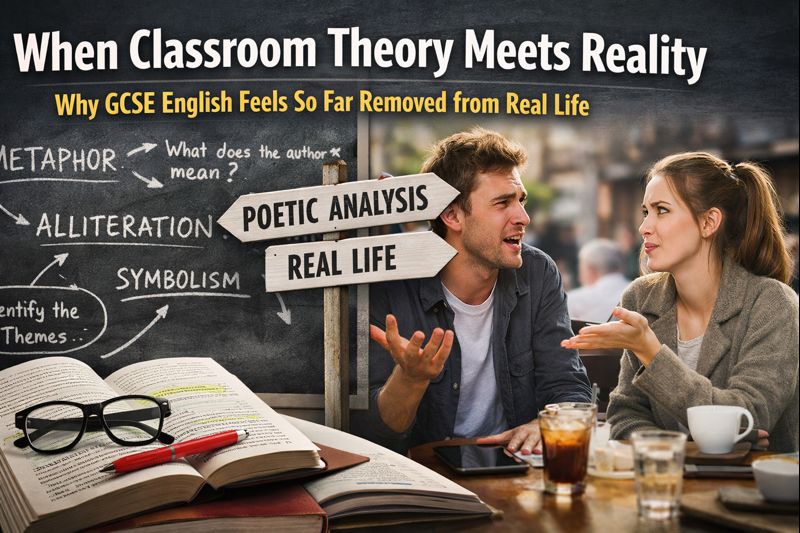
Few experiences are as universally relatable as the moment when classroom learning collides with reality and falls short. A comedy skit poking fun at GCSE English lessons taps directly into this shared frustration, using humour to highlight how the language taught in classrooms often feels detached from how people actually speak, think, and communicate once the lesson ends.
The skit centres on a familiar contrast. In the classroom, language is dissected, labelled, and examined with clinical precision. Students are taught to identify techniques, analyse intent, and extract meaning from carefully constructed texts. Outside the classroom, communication is messy, fast, and driven by context rather than theory. The humour emerges from placing these two worlds side by side and letting the disconnect speak for itself.
What makes the skit effective is its restraint. It does not attack education or dismiss the value of learning English. Instead, it highlights the absurdity that can arise when academic frameworks are applied too rigidly to everyday situations. A simple conversation becomes over analysed. A straightforward statement is loaded with imagined symbolism. The joke lands because audiences recognise how artificial that lens can feel beyond the exam paper.
There is a deeper tension beneath the laughter. GCSE English, like many academic subjects, is designed to teach critical thinking and analytical skills. Yet students often experience it as an exercise in decoding what examiners want rather than developing practical communication ability. The skit captures that frustration by showing how classroom language can feel impractical when stripped of lived context.
Humour works here because it validates a quiet truth. Many people leave school fluent in analysis but uncertain in expression. They can identify techniques yet struggle to articulate ideas naturally. The skit exaggerates this gap just enough to make it visible, without turning it into ridicule. It invites reflection rather than defensiveness.
The classroom setting also matters. Schools are environments built on structure and assessment. Real life is not. The skit highlights how rigid frameworks can lose relevance when removed from controlled conditions. In everyday interactions, meaning is shaped by tone, relationship, timing, and emotion. These elements rarely fit neatly into exam criteria, yet they dominate real communication.
There is a generational aspect as well. Many adults watching the skit recognise their own school experiences, despite changes in curriculum over time. This suggests the issue is not tied to one syllabus but to a broader challenge in education. How to balance theoretical understanding with practical relevance. Comedy becomes a way to surface this tension without prescribing solutions.
From a broader perspective, the skit reflects a common pattern across many systems. When frameworks are prioritised over context, they risk losing connection to lived experience. This is not unique to education. It appears in workplaces, institutions, and policies where process overtakes purpose. The humour resonates because it mirrors that wider experience.
At TMFS, we often see how clarity and relevance shape trust and engagement. Systems are most effective when they acknowledge reality rather than forcing reality to conform to rigid models. The skit’s success lies in showing what happens when that balance tips too far in one direction.
Ultimately, the comedy does not argue that GCSE English is useless. It suggests that learning becomes more meaningful when theory and reality are allowed to meet. Laughter fills the gap where frustration might otherwise sit, turning a shared irritation into a moment of connection.
By highlighting how classroom theory can feel disconnected from real life, the skit invites a simple question. How can learning better reflect the world it prepares people to enter. The joke does not answer that question. It simply makes it impossible to ignore.
All rights belong to their respective owners. This article contains references and insights based on publicly available information and sources. We do not claim ownership over any third party content mentioned.
DAILY WA © 2025
Daily WA Online is an independent news and media platform covering Western Australia. Owned by TMFS International Pty Ltd., we publish local stories, business insights, lifestyle features, and community voices for the digital era.