
Why Local Institutions Are Moving Away from Pure Agent Dependency
Across Perth and Western Australia, education providers are rebalancing their recruitment models as 2026 approaches. Rather than abandoning agents, institutions are reducing single-channel dependency to improve compliance control, brand consistency, and long-term stability. Perth-based strategist Miki Farmer explains that the shift reflects governance and risk management realities, as providers build diversified recruitment systems aligned with modern student behaviour.
TECHNOLOGY & INNOVATION
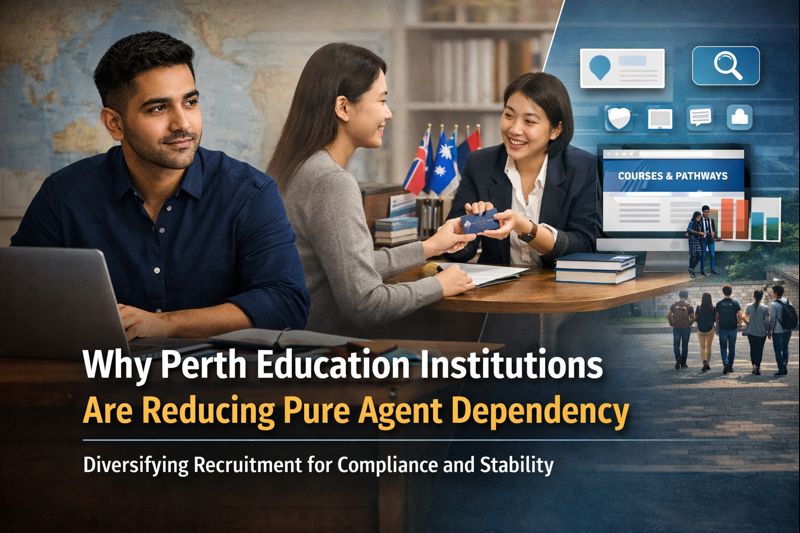
Across Perth and Western Australia, education institutions are reassessing a long-standing pillar of student recruitment: heavy reliance on education agents. While agents continue to play a role in the international education ecosystem, 2026 is shaping up as a turning point. Increasingly, providers are choosing to reduce pure dependency on agents and build more diversified recruitment and marketing structures.
This shift is not ideological. It is operational. It reflects observable changes in student behaviour, compliance risk, market volatility, and institutional governance.
According to Miki Farmer, a Perth-based marketing strategist working closely with education providers and training organisations, the change is less about abandoning agents and more about recalibrating control.
“What institutions are doing now is not cutting agents off,” Farmer notes. “They are reducing single-point dependency because it introduces risk across recruitment, compliance, and brand integrity.”
The Historical Role of Agents in WA Education
For decades, education agents have been central to international student recruitment in Western Australia. They provided access to overseas markets, handled counselling, and acted as intermediaries between institutions and prospective students.
For many providers, particularly RTOs and private colleges, agents offered speed and scale. Recruitment pipelines could be built quickly without substantial in-house marketing investment. In some cases, entire enrolment flows were managed externally.
However, this structure also meant that institutions had limited visibility into how their brand was represented, how expectations were set, and how students were qualified before arrival.
Rising Compliance and Governance Pressures
One of the clearest drivers behind the shift away from pure agent dependency is increased regulatory scrutiny.
Across WA, education leaders are observing that compliance risk often materialises downstream of agent-led recruitment. Issues related to student expectations, course suitability, attendance, and progression are frequently linked to how courses were presented at the recruitment stage.
In response, institutions are tightening oversight of messaging and student intake processes. This has led to a preference for recruitment channels that institutions can directly monitor and influence.
Farmer points out that governance concerns are now influencing marketing structure.
“Boards and senior leadership are asking where risk originates. When recruitment is entirely externalised, institutions have limited control over that risk.”
Changing Student Behaviour
Another observable shift is how students research education providers.
Prospective students—both international and onshore—are no longer relying solely on agents for information. They increasingly cross-check advice through institutional websites, search engines, social media, peer reviews, and independent platforms.
This behaviour has created pressure on providers to maintain a direct digital presence. Institutions without visible, credible online information are finding that agent recommendations alone are no longer sufficient to convert informed applicants.
In practice, this has meant greater investment in direct communication channels: content, search visibility, and student-facing explanations of pathways and outcomes.
Cost Structures and Margin Pressure
Agent commissions have also become a structural consideration.
While commissions remain an accepted cost of international recruitment, providers are becoming more conscious of margin erosion—particularly in a competitive pricing environment. Rising operational costs, trainer wages, and compliance requirements have made institutions more sensitive to recruitment efficiency.
Diversifying recruitment channels allows providers to balance acquisition costs. Direct marketing may require upfront investment, but it also creates reusable assets and longer-term visibility.
The result is not agent replacement, but cost rationalisation.
Brand Control and Message Consistency
Institutions in Perth are also recognising that brand consistency is difficult to maintain through distributed agent networks.
Different agents, operating in different markets, may describe the same course in varied ways. Over time, this creates misalignment between marketing, delivery, and student expectations.
To address this, providers are building centralised brand narratives and directing traffic toward controlled information sources. This allows institutions to set clearer expectations and reduce reputational risk.
Farmer describes this as a structural evolution.
“Institutions are moving from outsourced messaging to owned messaging. That’s a significant shift in mindset.”
Internal Capability Development
Another trend is the development of internal marketing and admissions capability.
Rather than relying exclusively on agents, institutions are investing in smaller internal teams focused on digital visibility, student communication, and lead qualification. These teams often work alongside agents rather than in competition with them.
This hybrid model allows providers to retain market access while improving data visibility and student quality control.
It also supports institutional learning. Over time, providers gain better insight into which messages resonate, which markets convert, and which pathways deliver sustainable outcomes.
Platform and Market Volatility
External volatility has also influenced decision-making.
Changes in visa policy, geopolitical conditions, and platform algorithms have made agent-only strategies less predictable. Institutions exposed to a narrow set of recruitment channels have experienced sharper enrolment fluctuations during periods of disruption.
Diversification is therefore being treated as risk mitigation rather than growth optimisation.
Reframing the Agent Relationship
Importantly, this shift does not signal the end of agents in WA’s education sector.
Instead, institutions are reframing the agent relationship. Agents are increasingly treated as one component within a broader recruitment ecosystem rather than the primary driver.
Institutions are placing greater emphasis on agent quality, alignment, and accountability, while reducing reliance on volume-based recruitment.
What this signals for providers
The move away from pure agent dependency signals a maturation of recruitment strategy across Western Australia’s education sector.
Providers are recognising that long-term stability depends on balance: between external reach and internal control, between speed and governance, and between volume and quality.
For education leaders and directors, the implication is clear. Recruitment strategy is no longer just an operational concern; it is a governance issue that intersects with compliance, brand integrity, and institutional resilience.
As Farmer summarises:
“The institutions adapting best are not rejecting agents. They’re building systems where no single channel carries the entire burden.”
In 2026, education providers in Perth are not withdrawing from global markets. They are building recruitment structures that are more transparent, more controllable, and better aligned with the realities of modern student behaviour.
DAILY WA © 2025
Daily WA Online is an independent news and media platform covering Western Australia. Owned by TMFS International Pty Ltd., we publish local stories, business insights, lifestyle features, and community voices for the digital era.